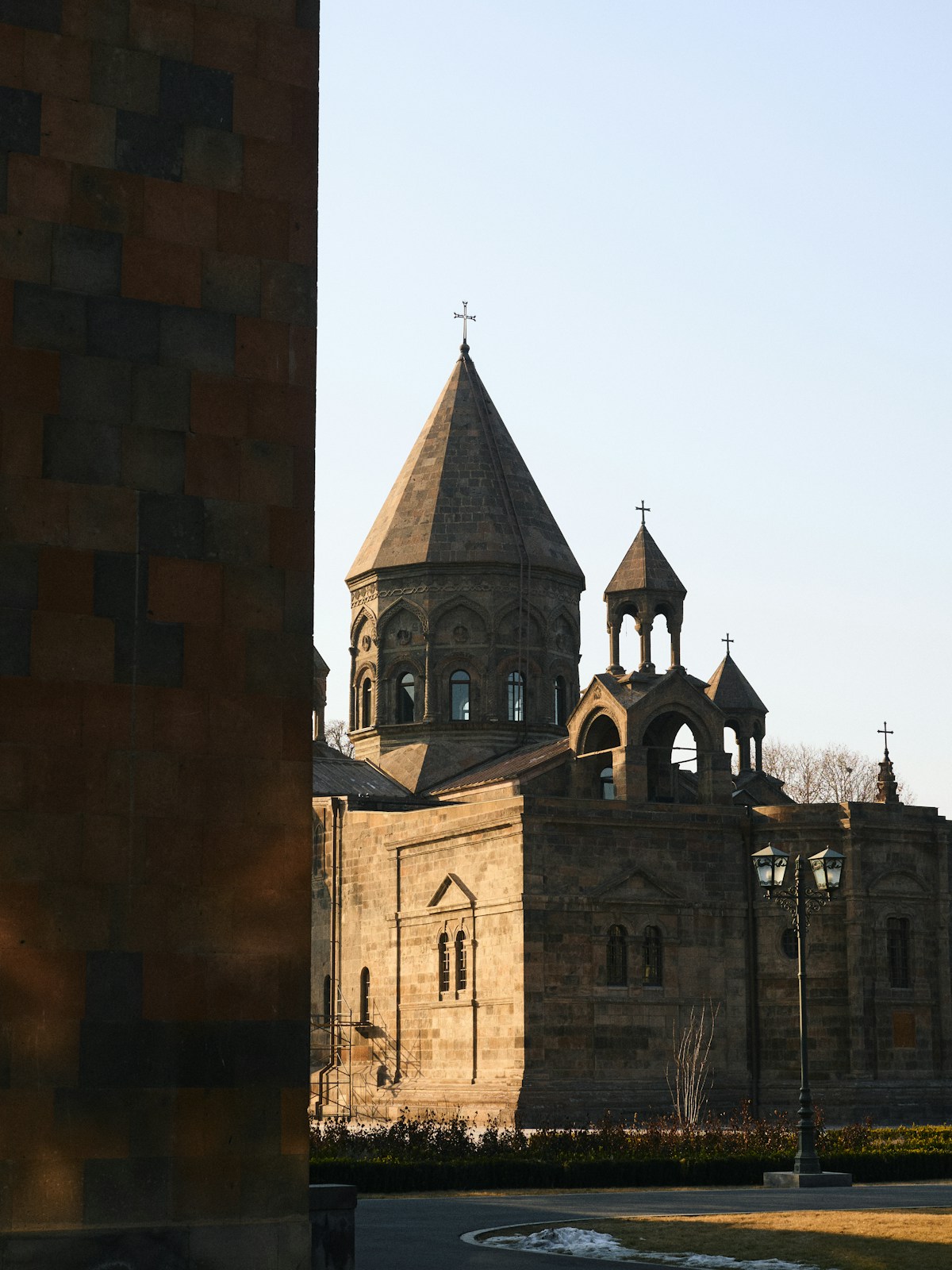
Etchmiadzin — officially renamed Vagharshapat but universally called by its ancient name — sits on the Ararat plain 20 km west of Yerevan. It has been the seat of the Armenian Apostolic Church for seventeen centuries, and the complex at its heart: the cathedral, the adjoining churches, and the treasury museum, represents the longest continuously inhabited centre of Armenian Christianity anywhere in the world.
The UNESCO World Heritage listing (2000) covers not just the main cathedral but the entire ensemble: Etchmiadzin Cathedral itself, Zvartnots Cathedral ruins 3 km east, and the standalone churches of Saints Hripsime and Gayane in the town. A well-planned day trip takes in all four sites and, with a small detour, adds a local winery to close the afternoon.
Getting There from Yerevan
Etchmiadzin is approximately 20 km west of Yerevan, 25–35 minutes by road depending on traffic. It is one of the most accessible day trips from the capital.
By marshrutka: Minibuses to Etchmiadzin depart from Yerevan’s Kilikia Bus Station and from stops on Mesrop Mashtots Avenue. The journey takes approximately 40–50 minutes and costs around AMD 350–500. Services run frequently during the day.
By taxi: A one-way taxi from central Yerevan costs approximately AMD 2,500–4,000 depending on your starting point. Round-trip with waiting time can be arranged for AMD 8,000–12,000.
By car: The fastest and most flexible option. The road is the M5 highway west, clearly signed. Parking at the cathedral complex is free and plentiful. See our guide to hiring a car in Armenia if you want to extend the day with a Mount Ararat or Khor Virap addition.
Morning: The UNESCO Cathedral Complex
Arrive by 09:00 if possible — the complex is quieter before tour groups arrive, and the light on the cathedral facade is best in the morning.
Etchmiadzin Cathedral (Mother Cathedral)
The Mother Cathedral of Holy Etchmiadzin is the spiritual and administrative centre of the Armenian Apostolic Church worldwide. The core structure dates to 301–303 AD, built under King Tiridates III following Gregory the Illuminator’s vision of Christ descending to earth and striking the ground here — etchmiatsin means “the only-begotten descended” in Armenian.
What you see today is the result of centuries of rebuilding and restoration — the current facades are largely 17th-century additions — but the plan and the foundational walls follow the original 4th-century footprint. The interior is richly decorated with frescoes, gold-leafed iconostasis work, and relics including what tradition holds to be a fragment of the True Cross and the spear used at the Crucifixion.
Entry to the cathedral itself is free. Plan at least 45–60 minutes to walk the nave, examine the frescoes at pace, and step into the side chapels.
The Treasury Museum
Directly adjacent to the cathedral is the Etchmiadzin Treasury Museum, which houses one of the most significant collections of early Christian relics and liturgical objects in the world. Highlights include illuminated medieval manuscripts, khachkars (carved cross-stones), embroidered vestments, and the reliquary of the Holy Spear (Geghard) — not the same as the monastery of the same name, but the relic itself, housed here since the 5th century.
Entry is approximately AMD 2,000. Guided tour of the museum adds another AMD 3,000–5,000 and is strongly recommended for first-time visitors — the explanations of the relics’ provenance make the collection coherent rather than overwhelming.
Saint Hripsime Church
A five-minute walk north of the cathedral square brings you to Saint Hripsime Church, built in 618 AD over the grave of Hripsime, a Roman Christian woman who fled persecution and was martyred in Armenia along with her companions. The church is compact and severe — stone walls roughly two metres thick, a conical dome typical of early Armenian design — and far less visited than the main cathedral.
The interior is simple and dark, intentionally austere, and all the more powerful for it. AMD 500 entry. Allow 20 minutes.
Saint Gayane Church
Five minutes further north: Saint Gayane Church, built in 630 AD, smaller still than Hripsime and similarly well-preserved. This is Gayane, the abbess who led the group of fleeing Christians. The church is often unlocked but unattended — small coins left at the entrance are expected rather than a formal entry fee.
Midday: Lunch Before Zvartnots
Return to central Etchmiadzin for lunch. The streets around the cathedral square have several cafes and restaurants serving standard Armenian fare: grilled trout, khorovats (barbecue), manti (small dumplings in broth), and lavash with local cheeses. Budget approximately AMD 4,000–7,000 per person.
The Etchmiadzin market area near the bus station also has small stalls selling churchkhela (walnut-and-grape-syrup candy), dried fruits, and local honey — good provisions for the afternoon.
Afternoon: Zvartnots Ruins
Zvartnots Cathedral ruins are 3 km east of Etchmiadzin, a 10-minute drive or a 35-minute walk along the highway. A taxi from the cathedral square costs AMD 800–1,200.
Zvartnots (“Cathedral of the Vigilant Forces”) was built between 641–661 AD under Catholicos Nerses III. At the time of its construction it was the largest church in the Armenian world — a three-tiered rotunda some 45 metres high — and was intended to impress the Byzantine Emperor Constans II, who visited Armenia in 651 AD. It stood for barely 300 years before collapsing in an earthquake, probably around 930 AD.
What remains is the circular foundation with its carved column capitals, the partial walls of the lower tier, and a museum pavilion on site that reconstructs the building in model form. The reconstruction model alone is worth the visit — it conveys the scale and ambition of the original in a way that walking the stones alone cannot.
Entry approximately AMD 1,500. The site museum is included. Plan 60–90 minutes — the grounds are open and the view of Mount Ararat from the perimeter is among the best on the plain.
Late Afternoon: Winery Visit
Etchmiadzin and the Ararat plain are home to several of Armenia’s larger wine and brandy producers. A late-afternoon visit is easy to combine with the drive back toward Yerevan.
Etchmiadzin Wine operates a small production facility and tasting room near the town and offers tastings of their red and white wines from local varietals including Areni Noir and Kangun. Sessions are informal and inexpensive — approximately AMD 2,000–3,000 for a four-wine tasting. Call ahead to confirm hours.
Maran Winery, closer to the Yerevan road, focuses on natural and minimal-intervention wines from Armenian indigenous grapes. This is one of the more interesting small producers on the plain — the tasting room is casual, the wines are experimental in the best sense, and the staff are accustomed to walk-in visitors.
For a larger-scale brandy experience, the Ararat Yerevan Brandy Company is back in the city itself and worth an evening visit on a different day — its cellars hold barrels dating back decades.
If You’re Staying Overnight
Etchmiadzin is most commonly visited as a day trip, but staying the night gives you the cathedral at sunrise and the quieter evening atmosphere of a pilgrimage town rather than a tourist one.
The town has a handful of guesthouses and small hotels near the cathedral complex. Our full where to stay in Etchmiadzin guide covers the best options by price tier, from simple guesthouses to the few proper hotels in the vicinity.
Extending the Day
Khor Virap (25 km south of Etchmiadzin): The classic Ararat view is from this monastery on the edge of the Closed Zone. If you have a car, the addition adds 60–90 minutes and is worth it in clear weather.
Sardarapat Memorial (35 km west): The Armenian victory monument commemorating the 1918 battle that prevented the Ottoman advance on Yerevan. The museum is excellent and rarely crowded.
Yerevan airport proximity: Etchmiadzin is 8 km from Zvartnots International Airport. If you have an evening flight, a final Zvartnots stop before the airport is a genuinely low-effort addition.
Practical Notes
Best time: April–June and September–October. Midsummer is very hot on the Ararat plain (often 35°C+). Winter is cold but clear, and the complex is beautiful in snow.
Dress code: Shoulders and knees must be covered inside all churches. Shawls are available at the entrance to the main cathedral.
Photography: Permitted throughout the complex. No flash inside the treasury museum.
Budget: Approximately AMD 7,000–12,000 per person for entry fees, lunch, and winery tasting, excluding transport and accommodation.
Where to stay: If extending to an overnight, see our Etchmiadzin where-to-stay guide for vetted accommodation options.
Book Your Trip
Flights — search and compare on Aviasales eSIM — stay connected with Airalo Travel insurance — get covered with EKTA Airport transfers — book with Kiwitaxi or GetTransfer Car rental — compare with GetRentaCar Hotels — compare and book accommodation on Booking.com Tours and activities — browse GetYourGuide