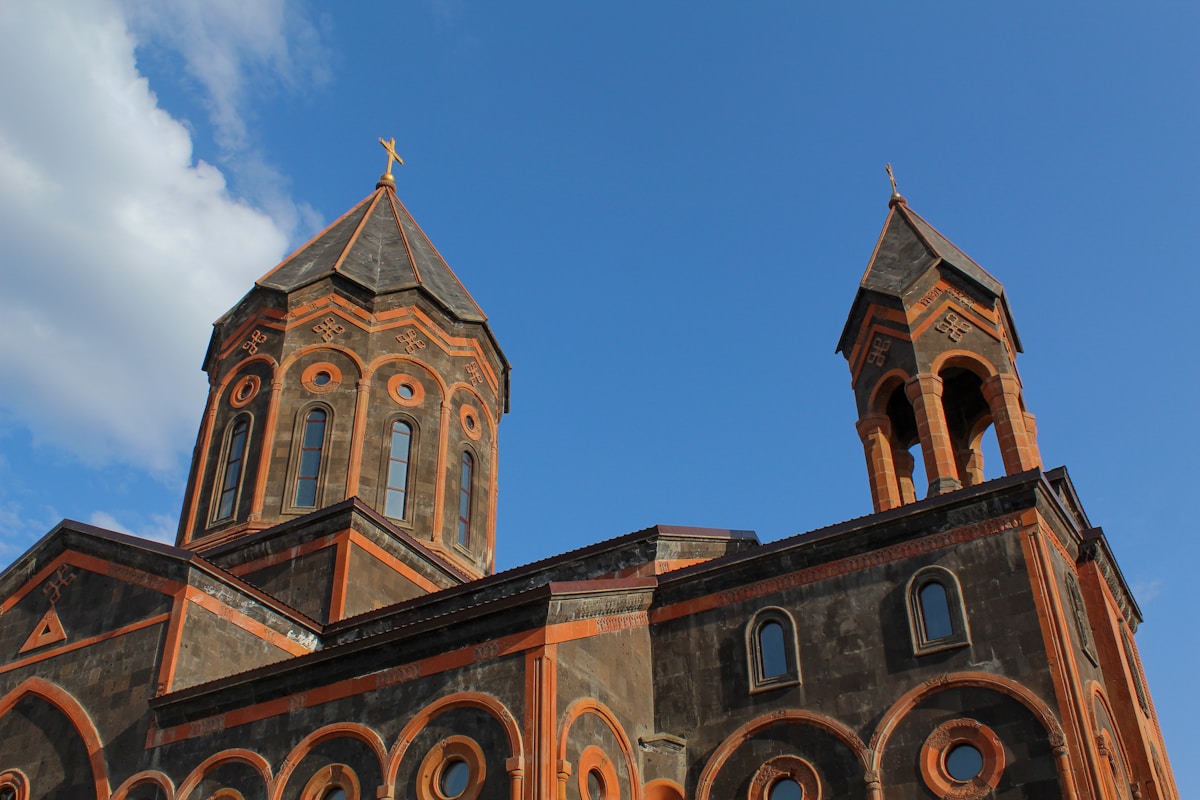
Gyumri is Armenia’s second city and one of its most rewarding day trips from Yerevan. The 125 km drive northwest takes you to a place that feels entirely distinct from the capital: black-tuff stone streets, tsarist-era mansions, Soviet-era apartment blocks weathered into something almost poetic, and a population with a reputation for wit and artistic temperament. This itinerary covers a full day, arriving mid-morning and returning to Yerevan after dinner.
Getting from Yerevan to Gyumri
By car or rental: The M1 motorway runs most of the way, dual carriageway from Yerevan until the approach to Gyumri. The drive is approximately 1 hour 50 minutes without stops. The road passes through the Aragats highlands, offering views of Mount Aragats (4,090 m) to the east on clear days. Petrol stations are available in Aparan and on the outskirts of Gyumri. Car hire in Armenia is straightforward if you want the flexibility to stop at Harichavank Monastery on the way.
By marshrutka (minibus): Depart from Kilikia Bus Station in Yerevan (also known as Sosebi). Minibuses run from approximately 08:00 and the journey takes 2–2.5 hours, stopping in Aparan. Cost: approximately AMD 1,500–2,000 (roughly USD 4–5) each way. Marshrutkas back to Yerevan typically run until around 18:00–19:00 - confirm the last departure time with the driver or at the station.
By train: Yerevan railway station to Gyumri takes approximately 2.5–3 hours. Tickets cost around AMD 1,500–2,000. The service runs a few times daily. The train station in Gyumri is a 10-minute walk from the city centre, though taxis are available.
By organised tour: Group day tours from Yerevan start at approximately USD 35–50 per person, run 8–9 hours, and typically include transport, a guide, and entrance fees. Book a Gyumri day tour here.
Morning: Kumayri Historic District
Arrive in Gyumri and head straight for the Kumayri Historical and Architectural Reserve - a 20-hectare protected zone in the heart of the old city. This is the reason most visitors come to Gyumri. The district is defined by its black and grey tuff stone buildings: 19th-century mansions with ornate carved facades, arched windows, and wooden balconies, many of which survived the devastating 1988 earthquake better than the Soviet-era apartment blocks surrounding them.
What to see in Kumayri
Surb Amenaprkitch Church (The Saviour’s Church / Yot Verk): This Russian-Orthodox-influenced church, built between 1858 and 1873 from black tuff, is the most photographed building in Gyumri. Its geometric dome and dark stone give it an extraordinary visual weight. The interior is austere - rough stone walls and candle smoke - quite different from the gilded Orthodox churches you might expect. Entry is free.
Surb Sarkis Cathedral: Located on Shahumyan Street, this 19th-century Armenian Apostolic church anchors the central part of Kumayri. It was severely damaged in the 1988 earthquake and reconstructed in the years following. The adjacent bell tower is a Gyumri landmark.
The Artisan Workshops: The streets off Abovyan Street and around the central park house small workshops where craftspeople make traditional Armenian metalwork, ceramics, and lace. These are working studios, not tourist traps - you can watch artisans at work and buy directly. Prices for hand-made copper items start from around AMD 3,000–5,000 (USD 8–13).
Vardanants Square: The main public square, with its monument to Vardanantz heroes, is the social heart of Kumayri and a good orientation point. Cafés around the square open early and are a good place for an Armenian coffee (around AMD 400–600) before the main sightseeing.
Allow 2.5–3 hours for a thorough walk through Kumayri.
Late Morning: Aslamazyan Sisters Museum of Fine Arts
The Aslamazyan Sisters Museum (officially the Art Gallery of Marianne and Yeranuhi Aslamazyan) on Abovyan Street is one of the best small art museums in Armenia and deserves at least an hour. The collection spans work by the two Gyumri-born sisters - Marianne (1907–2006) and Yeranuhi (1910–1998) - who were among the most celebrated Armenian painters of the 20th century, their style combining Soviet social realism with Armenian folk motifs and vivid Mediterranean colour. The building itself is a restored 19th-century tuff mansion.
Entry costs approximately AMD 1,500–2,000 (around USD 4–5). The gallery is open Tuesday to Sunday, 10:00–18:00. A small permanent collection is supplemented by rotating exhibitions of other Armenian artists.
Lunch: Khinkali and Local Food
Gyumri is famous among Armenians for its khinkali - juicy, broth-filled dumplings. The origins are debated (the form is Georgian, but Gyumri’s version has become its own thing), and eating them here is considered a city-specific experience. Several small restaurants and canteen-style places around the central market serve them from AMD 250–350 per piece; a satisfying lunch is 6–8 dumplings.
For a sit-down meal, Paparazzi Restaurant on Gorky Street serves traditional Armenian mezze alongside grilled meats and local beer. Mains range from AMD 2,500–5,500 (USD 6–14). Laguna Restaurant near Kumayri offers similar Armenian classics in a restored stone interior. Budget approximately AMD 4,000–7,000 for a two-course lunch with drinks at either.
Afternoon: Earthquake Memorial, Black Fortress & City Walks
The 1988 Earthquake Memorial Area
The 1988 earthquake (magnitude 6.8) killed approximately 25,000 people across the Spitak-Gyumri region. Walking the city today, the evidence is still visible: rusting freight containers that became long-term homes for displaced families, unreinforced Soviet apartment blocks with missing floors. The memorial cemetery in the northeast of the city commemorates those killed. This is a sombre but important context for understanding modern Gyumri - the city has been rebuilding for nearly four decades.
Black Fortress (Sev Berd)
The Black Fortress (Sev Berd) is a 19th-century Russian military fortification on the northeastern edge of the city, built between 1834 and 1847 to guard the tsarist empire’s southern frontier. The fortress is partially open and partially ruined - entry is informal, often free, and involves some scrambling over uneven ground. The ramparts offer good views over the Shirak Plain. Allow 45–60 minutes.
Dzitoghtsyan Museum of National Architecture and Urban Life
If you have time and interest, the Dzitoghtsyan Museum (also called the Museum of Urban Life) on Antranik Street is a restored 19th-century merchant’s house with period furnishings, regional costumes, and displays covering Gyumri’s pre-earthquake architectural heritage. Entry costs approximately AMD 1,500. Closed Mondays.
Evening: Café Culture and Departure
Gyumri’s café and bar scene is genuinely worth experiencing before heading back. The city has a reputation for its concentrated creative community - local musicians, visual artists, and writers have made the Kumayri area their base, and small bars and cafés reflect this. Black Dog on the main square is a popular spot for local craft beer (from AMD 1,200 per glass) and straightforward Armenian food.
If returning to Yerevan by marshrutka, aim for the 18:00 departure from Gyumri bus station to be safe. Taxis back to Yerevan can be arranged from the city centre for approximately AMD 10,000–15,000 (USD 26–39) - negotiate in advance.
Adding Harichavank Monastery
If travelling by car, Harichavank Monastery (12th–13th century) is 45 minutes southeast of Gyumri on the road toward Artik. The monastery is set in a gorge above the Akhuryan River and receives very few visitors despite being architecturally significant - the main Church of Saints Gregory and Karapet dates to 1201. Allow 45 minutes for the visit and add an hour to your total driving time.
Sample Day Schedule
| Time | Activity |
|---|---|
| 08:00 | Depart Yerevan (by car, marshrutka, or organised tour) |
| 10:00 | Arrive Gyumri, begin Kumayri Historic District walk |
| 12:30 | Aslamazyan Sisters Museum |
| 13:30 | Lunch (khinkali near market, or sit-down at Paparazzi) |
| 14:30 | Black Fortress and city walk |
| 16:00 | Dzitoghtsyan Museum (optional) |
| 17:00 | Café on Vardanants Square |
| 18:00 | Depart Gyumri for Yerevan |
| 20:00 | Arrive Yerevan |
Practical Information
Where to stay if extending to one night: The Gyumri hotel guide covers accommodation options from guesthouses (from AMD 15,000/night, approximately USD 39) to boutique hotels in restored tuff buildings. An overnight stay lets you see the city without rushing and experience the evening atmosphere in Kumayri.
Weather: Gyumri sits at 1,550 m altitude and is considerably colder than Yerevan - especially from October to April. Temperatures can be 5–8°C lower than the capital. Bring a layer regardless of season.
Money: Gyumri has ATMs but fewer than Yerevan. Withdraw cash in Yerevan or use the ATMs near Vardanants Square.
Language: Russian is more commonly spoken in Gyumri than in Yerevan. English is limited outside tourist-facing businesses.
For organised tours from Yerevan that cover Gyumri alongside other northern highlights, browse available day tours here.