Two weeks in Armenia gives you enough time to move beyond the standard Yerevan day trips and see the country properly. You can cover the deep south - Tatev, Goris, the Vorotan Gorge - as well as the forested north-east around Dilijan, the high shores of Lake Sevan, and Gyumri in the north-west. This itinerary is paced for independent travellers who want flexibility without being rushed.
The best months to run this trip are May–June or September–October. Spring brings wildflowers across the highland plateau; autumn turns the Dilijan forests amber and gives clearer views of Ararat before the winter clouds close in.
You will need a hire car for roughly half of this itinerary - specifically the south (Days 4–6) and the Dilijan–Sevan–Gyumri loop (Days 9–13). Marshrutkas work for some legs but not all. We recommend comparing car hire rates through GetRentacar before you arrive - local agencies at Zvartnots are often 20–40% cheaper than international brands, and availability tightens in summer.
Days 1–3: Yerevan
Spend the first three days in the capital. Yerevan is compact and easy to navigate on foot, and there is more here than most visitors expect.
Day 1 - Orientation
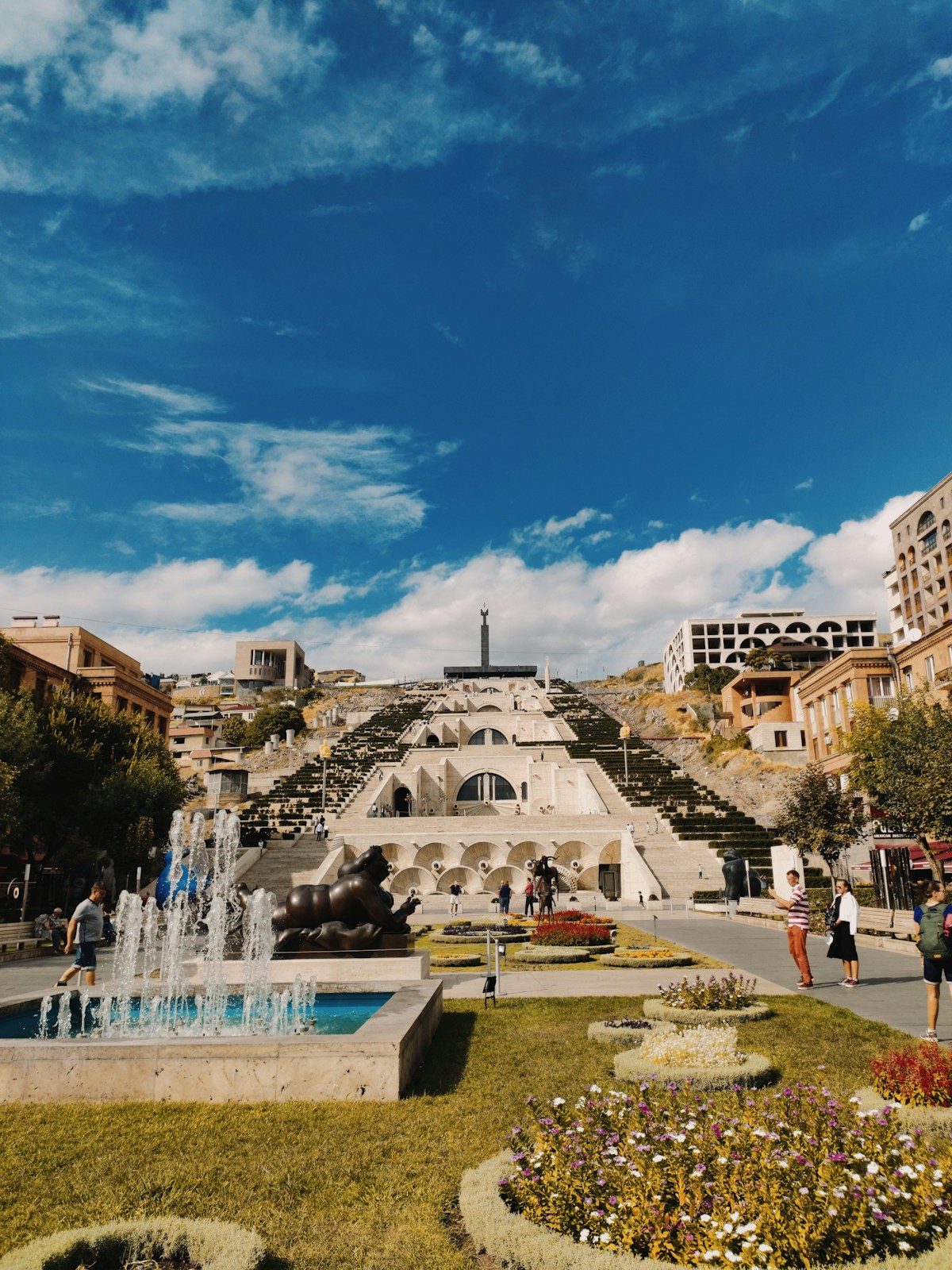
Arrive at Zvartnots Airport (12 km west of the city centre, 20–30 minutes by taxi or the GG app). Check in and spend the afternoon walking the city. Start at Republic Square - the central hub, ringed by buff-and-rose tuff buildings - then head north along Northern Avenue toward the Opera House. In the evening, take the escalators up the Cascade for views over the rooftops toward Ararat.
Eat: The area around Abovyan Street and the Cascade has a concentration of good cafés and restaurants. Serjik’s, Lavash, and Sherep are all reliable options.
Stay: Central Yerevan, within walking distance of Republic Square. See our Yerevan accommodation guide for options across all budgets. Search hotels in Yerevan on Booking.com
Day 2 - Culture and Markets
Morning at the Matenadaran - the Institute of Ancient Manuscripts holds thousands of medieval Armenian texts and is one of the most important cultural institutions in the country. Allow 1.5 hours. Guided tours are available and add significant context.
Afternoon: visit the Vernissage Market (weekends only; on weekdays substitute a walk through the GUM Market off Mashtots Avenue instead). Vernissage has khachkar carvings, handmade jewellery, Soviet memorabilia, and locally produced cognac. It is one of the better craft markets in the South Caucasus.
Evening: walk the Hrazdan Gorge below the city if the light is good. The gorge is accessible from several points near the Cascade and gives a completely different perspective on the city.
Day 3 - Brandy, Garni Preview, and Departure Prep
Morning: tour the Ararat Brandy Factory near the Hrazdan Gorge. The factory tour covers the entire production process from barrel ageing to bottling and ends with a tasting. Armenia’s brandy is genuinely world-class. Tours run at set times and cost around 6,000–10,000 AMD per person.
Afternoon: buy provisions for the road at the GUM Market, and sort logistics - book the car hire if you haven’t already, confirm accommodation in Goris, and check the GYG tours page for Tatev options in case you prefer a guided day there.
Day 4: Yerevan → Khor Virap → Noravank → Goris
Distance: ~230 km | Driving time: ~3.5–4 hours with stops
Leave Yerevan early - by 8am. The route south on the M2 passes through the Ararat plain.
Khor Virap (35 km south of Yerevan): the single most-photographed site in Armenia - a medieval monastery on the flat plain with Ararat rising directly behind it across the Turkish border. Arrive before 10am for the best light. The pit below the church (khor virap means “deep dungeon”) is where St. Gregory the Illuminator was imprisoned for 13 years. Descend via the iron ladder - it is narrow but manageable. Allow 1–1.5 hours.
Noravank (a further 1.5 hours south, via Areni village): a 13th-century monastery in a dramatic narrow canyon of red limestone. The two-storey Church of St. Astvatsatsin - with its steep external staircase leading to the upper chapel - is the standout structure. Arrive in the afternoon when the light rakes the canyon walls from the west. Allow 1.5 hours.
Continue south through the Vayots Dzor highlands and over the Vorotan Pass (~2,000 m) to Goris. Arrive by early evening. Goris is a pleasant small town with a good range of guesthouses and one of the better café scenes outside Yerevan.
Eat: Several restaurants on and near the main street serve standard Armenian food - khash, khorovats, dolma.
Stay: Mirhav Hotel or one of the family-run guesthouses in the old stone quarter. Book ahead in summer.
Days 5–6: Tatev and the Vorotan Gorge
Day 5 - Tatev
Drive 30 km from Goris to the Wings of Tatev cable car station at Halidzor village. The cable car - 5.7 km long, opened in 2010, formerly the world’s longest reversible aerial tramway - descends 320 metres into the Vorotan Gorge. The journey takes about 12 minutes and the views of the canyon are exceptional.
Tatev Monastery (9th–13th century) sits on a basalt plateau at the end of the cable car line. The main church, gavit (narthex), and the oscillating Gavazan Column are all worth exploring carefully. The column was designed to warn of earthquakes - it sways several centimetres in response to seismic activity. Allow 2 hours minimum.
The cable car runs approximately every 15 minutes; last descent is around 6pm (check seasonally). Entry to the cable car costs around 6,000 AMD return per person (2026 prices).
Return to Goris by cable car in the afternoon.
Day 6 - Goris Old Quarter + Shaki Waterfall
Spend the morning exploring the old stone quarter of Goris - the older part of town is built from and into the karst rock, with stone-carved houses many centuries old. The streets are quiet and the architecture is unlike anywhere else in Armenia.
Afternoon: drive to Shaki Waterfall, roughly 15 km from Goris near the village of Shaki. A seasonal waterfall that runs strongest in spring (April–May) and early summer, dropping about 18 metres over a basalt shelf. A 20-minute walk from the road. Worth the short detour if water levels are up.
Return north toward Yerevan on the M2, stopping for the night partway or pushing through to Stepanavan (see Day 7).
Days 7–8: Stepanavan and the Northern Forests
Day 7 - Drive to Stepanavan
Distance from Goris to Stepanavan: ~310 km | Driving time: ~4.5–5 hours
This is a long driving day. Leave Goris early. The route goes back north through Yerevan (or bypass on the outer ring road) and continues north into the Lori Province. Stepanavan sits in a forested valley at the northern edge of the Armenian highland.
Stepanavan Dendropark is a modest attraction - a Soviet-era botanical garden with a significant tree collection - but the town itself is a base for the surrounding landscape. The area around Lori Berd (a medieval fortress above the Debed River gorge) is the main sight; the fortress is partially ruined but the canyon scenery makes the short walk worthwhile.
Stay: Stepanavan has a limited accommodation range - guesthouses and one or two small hotels. Alternatively, base yourself in Alaverdi (further east along the Debed Canyon), which has slightly more options. Search hotels in Alaverdi on Booking.com
Day 8 - Haghpat and Sanahin Monasteries
Two UNESCO World Heritage monasteries within 5 km of each other in the Debed Canyon near Alaverdi - among the most significant medieval ecclesiastical buildings in the South Caucasus.
Haghpat Monastery (10th–13th century): the larger and better-preserved of the two. The main church, the gavit, and the bell tower are all in good condition. The setting - on a forested plateau above the canyon - is dramatic. Allow 1.5–2 hours.
Sanahin Monastery (10th century): slightly older and slightly smaller, set in the village of the same name. The carved stone details on the khachkar crosses are exceptionally fine.
Both are free to enter. The canyon road between them involves some slow driving but no technical difficulty. For a detailed self-drive route through the full Debed Canyon - including Akhtala, Odzun, and the side roads - see our Debed Canyon driving guide. From here, route south toward Dilijan - about 90 km, 1.5 hours.
Days 9–10: Dilijan
Dilijan is Armenia’s most visited resort town - a forested highland town at around 1,500 metres, sometimes called the “Armenian Switzerland” for its landscape. The comparison is loose but the forested slopes and cool summers are genuinely distinctive by Caucasus standards.
Day 9 - Old Town and Haghartsin Monastery
Walk the old town quarter of Dilijan in the morning - the cluster of restored 19th-century stone workshops and houses around Sharambeyan Street is the most architecturally intact area in town. Several craft workshops operate here; the woodcarving tradition is particularly strong.
Afternoon: drive 18 km east to Haghartsin Monastery - a 10th–13th century complex deep in a forested gorge. The three churches and the refectory hall are all well-preserved. The forest setting makes it feel remote even though it is on a sealed road. Allow 1.5 hours.
Return transport: from Yerevan to Dilijan by marshrutka, 2 hours from Kilikia bus station, ~1,500 AMD. From Dilijan to Haghartsin, local taxi, ~3,000–4,000 AMD return.
Day 10 - Hiking in the Dilijan National Park
Dilijan National Park covers 25,000 hectares of mixed broadleaf forest. Several marked trails run from the town. The most popular is the Gosh to Haghartsin trail (~10 km, 3–4 hours), which connects Gosh village and its monastery to Haghartsin through the forest. The trailhead at Gosh is accessible by taxi from Dilijan (~5 km).
Other options: the Jukhtak Valley trail, accessible from the edge of town, is shorter (4–5 km return) and good for a half-day walk.
Stay: Dilijan has a good range of accommodation including eco-cabins, guesthouses, and resort hotels. The area around the old town and the forest edge is the best location. See our Dilijan guide for details. Search hotels in Dilijan on Booking.com
Days 11–12: Lake Sevan
Lake Sevan is 60 km south-east of Dilijan - about 45 minutes by car, or 30 minutes on the marshrutka that runs the Dilijan–Sevan–Yerevan route.
Day 11 - Sevanavank and the Northern Shore
Sevanavank Monastery sits on a peninsula (once an island before Soviet water management lowered the lake level) jutting into the southern end of the lake. Two 9th-century churches with panoramic views. Walk up from the car park - 10 minutes, 200 stone steps. Allow 1 hour.
Drive the northern shore road for views and wind. Charents Arch - a basalt arch on the road above the lake - frames Ararat on clear days and is worth the short stop.
Lunch: fresh ishkhan (Armenian trout, native to Sevan) at one of the restaurants along the shore road. This is the right place to eat it.
Day 12 - Sevan Town, Noratus, Swimming
Explore Sevan town itself - relatively functional but with a good market and cafés. The Noratus Cemetery (15 km south of Sevan town near Noratus village) is one of the largest surviving khachkar fields in Armenia - hundreds of medieval carved cross-stones in various states of preservation, in an open field above the road. A sobering and impressive sight.
In summer, the lake shore is warm enough for swimming. The water temperature reaches 20–22°C in July–August; it is cold in May and June.
Stay: Sevan town and the northern shore have hotels and guesthouses. See our Lake Sevan guide for recommendations. Search hotels in Sevan on Booking.com
Day 13: Gyumri
Gyumri is Armenia’s second city - a place that carries the weight of the 1988 earthquake (which killed an estimated 25,000 people in the city and surrounding region) alongside a deep arts and craft tradition that pre-dates Soviet rule.
Distance from Sevan to Gyumri: ~165 km | Driving time: ~2.5 hours (via Yerevan outer ring road or through the city)
Morning: Walk the old city quarter around Kumayri - the pre-earthquake district of 19th-century black tuff buildings. Many are being restored; others remain ruined. The contrast between the intact older district and the Soviet-era residential blocks that replaced most of the city is stark.
Key sites:
- Yot Verk (Seven Wounds) Church - one of the city’s most striking 19th-century black tuff churches
- Dzitoghtsyan Museum (City Historical Museum) - strong collection on local history, the earthquake, and traditional Gyumri crafts
- Aslamazyan Sisters Gallery - a private collection of early-20th century Armenian avant-garde art, housed in a restored mansion
Lunch: Gyumri has a good café and restaurant scene, concentrated around the main square and the Kumayri district. The city is less expensive than Yerevan for food.
Stay: Several good hotels and guesthouses in the Kumayri area. Overnight in Gyumri and drive back to Yerevan on Day 14. Search hotels in Gyumri on Booking.com
Return transport from Sevan to Gyumri without a car: marshrutkas run from Sevan to Yerevan (~1 hour, ~900 AMD), then Yerevan Kilikia bus station to Gyumri (~1.5 hours, ~1,200 AMD). The train also runs Yerevan–Gyumri (2.5 hours, ~1,200 AMD) - slower but more comfortable.
Day 14: Return to Yerevan, Departure
Distance from Gyumri to Yerevan: ~125 km | Driving time: ~1.5–2 hours
Leave Gyumri after breakfast. The route south via the M1 highway crosses the Shirak plateau and descends into the Ararat Valley. Stop at Amberd Fortress (on the slopes of Mount Aragats, about 70 km from Gyumri) if time allows - a 7th–10th century fortress and 11th-century church at 2,300 metres, with views over the Ararat plain. The access road adds about 30 minutes each way.
Arrive back in Yerevan by early afternoon. Return the hire car to Zvartnots and allow time for a final lunch in the city. Most international flights from Zvartnots depart in the late afternoon or overnight.
Budget Notes
Costs across a two-week trip vary significantly depending on accommodation standard and transport choices. Rough daily budget in 2026 AMD:
- Budget: 15,000–25,000 AMD per person per day (guesthouses, self-catering where possible, marshrutkas)
- Mid-range: 30,000–55,000 AMD per person per day (3-star hotels, restaurant meals, hire car shared between two people)
- Car hire: budget roughly 20,000–35,000 AMD per day for a standard car from a local agency
Carry local currency for rural areas - cards are not always accepted outside Yerevan and the main resort towns. ATMs are reliable in Yerevan, Gyumri, Dilijan, and Sevan; less so in smaller towns. See our Armenia money guide for full details.
For travel insurance, we recommend sorting this before departure - medical costs in Armenia are manageable but evacuation cover matters for mountain hiking. EKTA covers single-trip Armenia visits straightforwardly.
Practical Summary
| Leg | Transport | Approx. time | Approx. cost (AMD) |
|---|---|---|---|
| Yerevan → Goris | Hire car or private driver | 3.5–4 hrs | - |
| Goris → Tatev cable car | Hire car | 45 min | - |
| Goris → Stepanavan | Hire car | 4.5–5 hrs | - |
| Stepanavan → Dilijan | Hire car | 1.5 hrs | - |
| Dilijan → Sevan | Marshrutka or hire car | 30–45 min | ~900 AMD |
| Sevan → Gyumri | Marshrutka via Yerevan | 2.5 hrs | ~2,100 AMD |
| Gyumri → Yerevan | Car or marshrutka | 1.5–2 hrs | ~1,200 AMD |
Book Your Trip
Flights - search and compare on Aviasales · flights guide eSIM - stay connected with Airalo · eSIM guide Travel insurance - get covered with EKTA · insurance guide Airport transfers - book with Kiwitaxi or GetTransfer · airport guide Car rental - compare with GetRentaCar · car hire guide Hotels - compare and book accommodation on Booking.com Tours and activities - browse GetYourGuide
Related Guides
- 5-day central Armenia itinerary
- 7-day south Armenia itinerary
- Tours in Armenia for organised alternatives to self-driving
- Getting around Armenia - hire car, marshrutkas, and transfers explained