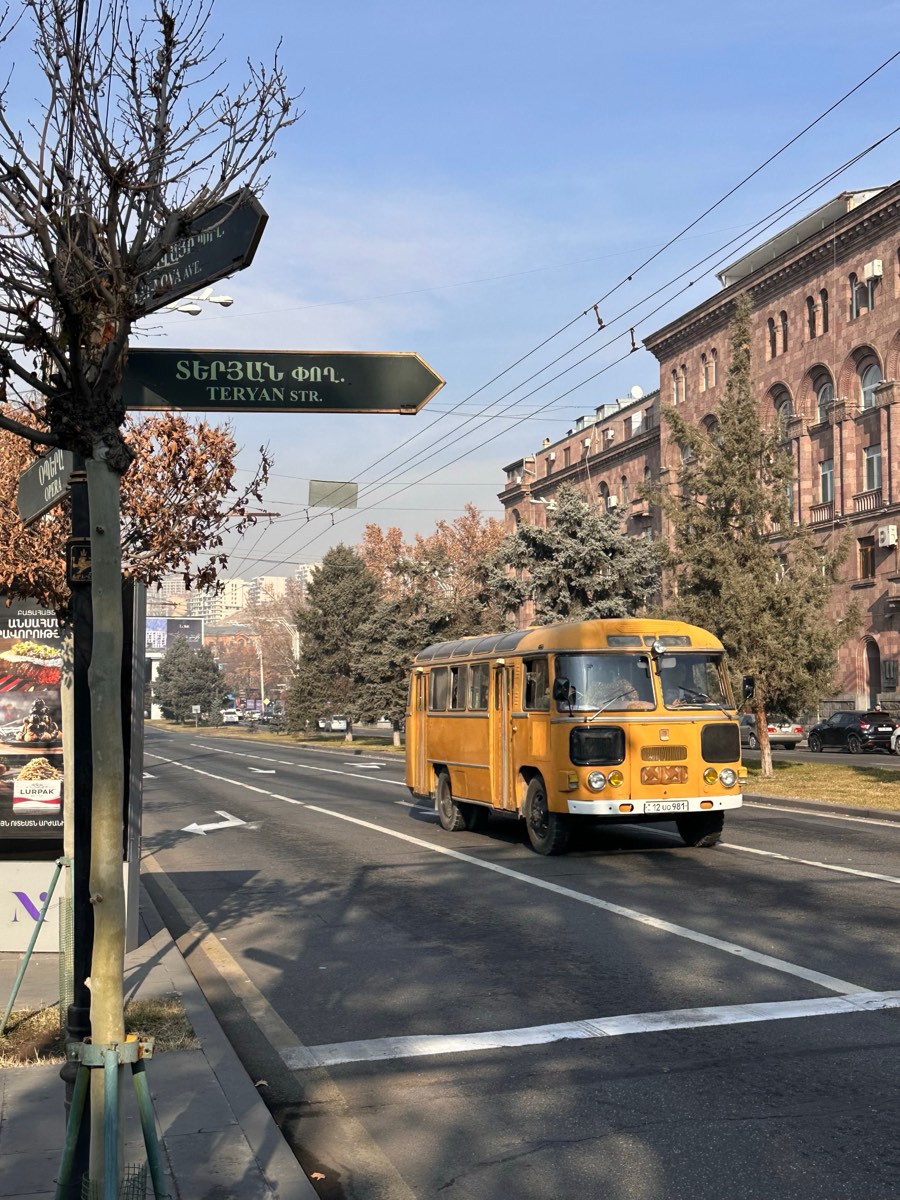
The marshrutka (маршрутка, from “marshrutnoye taksi” — route taxi) is a shared minibus that operates on a fixed route but stops wherever passengers request. It’s the dominant form of cheap transport in Yerevan and the primary way to get between cities and towns across Armenia. Fares are low, coverage is wide, and once you understand the system, getting around Armenia becomes significantly easier.
Marshrutkas in Yerevan
Yerevan’s marshrutkas operate numbered routes across the city. Each route number corresponds to a fixed corridor — the route number is displayed on the front window. You can flag one down anywhere along its route or board at a designated stop.
Fares: 100 AMD per ride within Yerevan (approximately $0.26 as of 2026). Fixed regardless of distance on that route.
How to board: Stand at the roadside and raise your hand. The driver will stop. Board through the front or side door. On shorter runs, you can pay the driver directly as you board; on busier runs, pass money forward when the van is moving.
How to exit: Say “Kanem” (կաnՆEM) — meaning “stop” — or tap the driver’s seat when approaching your stop. The driver will pull over. On some routes, calling out your stop by landmark (“Mashdots”/“Komitas”/“Malatia”) is more reliable than an exact address.
Yerevan also has a metro (two lines, 100 AMD per ride) and city buses. Marshrutkas fill the gaps — they serve residential areas and cross-city routes the metro doesn’t reach. For travel between Republic Square, Northern Avenue, and the Vernissage market, marshrutkas are faster than walking and far cheaper than a taxi.
Intercity Marshrutkas
The best-value way to travel between Armenian cities is the intercity marshrutka. These depart from Yerevan’s main station hubs — primarily Kilikia Autostation (Yerevan Central Bus Station) on Admiral Isakov Avenue, and Sasuntsi Davit hub near the metro station of the same name.
Key intercity routes and approximate fares (as of 2026):
| Route | Duration | Fare |
|---|---|---|
| Yerevan → Gyumri | 1.5–2 hrs | 1,500–2,000 AMD |
| Yerevan → Vanadzor | 1.5 hrs | 1,200–1,500 AMD |
| Yerevan → Dilijan | 1.5 hrs | 1,500 AMD |
| Yerevan → Goris | 4 hrs | 3,000–3,500 AMD |
| Yerevan → Sevan (Lake) | 1 hr | 700–900 AMD |
| Yerevan → Etchmiadzin | 30–45 min | 300–400 AMD |
| Yerevan → Tbilisi (Georgia) | 5–6 hrs | 5,000–7,000 AMD |
Intercity marshrutkas depart when full, not on a fixed timetable — though popular routes (Gyumri, Vanadzor) fill quickly and depart frequently in the morning. For the cross-border Yerevan–Tbilisi run, Omio lists available coaches with advance booking if you’d rather confirm a seat before you travel. For remote destinations like Tatev or Noravank, private taxis or a dedicated tour are more reliable than waiting for a marshrutka to fill.
What to Expect on Board
Marshrutkas are typically white Ford Transit vans or similar, holding 13–18 passengers. On intercity routes, you get a seat; standing is rare beyond urban Yerevan runs. Air conditioning is uncommon — windows provide the ventilation, and summer runs through the Armenian highlands can get warm.
Luggage goes in the boot/trunk or under your seat if it fits. Larger bags on intercity routes may prompt a small extra charge — negotiate with the driver before departure.
Drivers and passengers are predominantly Armenian-speaking. Outside Yerevan, Russian is the fallback second language; English is rarely spoken. For intercity travel, having your destination written in Armenian is genuinely useful. Google Translate handles Armenian and offline packs are available.
Practical Tips
- Cash only. No cards, no apps. Small denominations (500 and 1,000 AMD notes) are preferred.
- Marshrutkas don’t wait. When an intercity van fills, it leaves. For morning departures, arrive at the station 15–20 minutes early.
- No central schedule app. Departure times for intercity routes can be loosely tracked on yandex.com/maps (armenian city-to-city) or via the autostation itself — ask at the relevant bay.
- Night travel. Yerevan urban marshrutkas thin out significantly after 9pm. Intercity services are largely daytime-only.
- Etchmiadzin via marshrutka: Departs from Yerevan’s Gai Autostation (near Gai market), not Kilikia. Worth knowing separately — most first-time visitors miss this.
- Sevan: Marshrutkas to Lake Sevan depart from the Barekamutyun metro area. A quick, cheap day trip from Yerevan.
Marshrutka vs. Taxi vs. Train
Armenia’s rail network is limited — the Yerevan–Gyumri route is the main usable line, taking about 2.5 hours for a more comfortable but slower journey than the marshrutka. For speed and coverage, marshrutkas win across most destinations.
Taxis (both metered and app-based — GG Taxi and Yandex Go are widely used in Yerevan) offer door-to-door convenience at 5–10x the marshrutka fare. For groups of three or more, splitting a taxi to Gyumri or Dilijan can approach marshrutka pricing while offering more comfort. If you want a fixed price confirmed before you travel — particularly for airport arrivals or long intercity runs — pre-booked private transfers remove all the uncertainty. For multi-stop or group trips, GetTransfer operates on a bidding model where local operators compete for your route — particularly useful when you’re combining two or three sites in a day and want to negotiate the full itinerary upfront.
The marshrutka’s advantage is simple: it goes everywhere, costs almost nothing, and leaves when it’s full. For independent travel through Armenia, it’s indispensable.
For the popular Yerevan–Tbilisi route specifically — including what the border crossing involves and when a private transfer makes more sense — see our Yerevan to Tbilisi transport guide.
Plan your Armenia trip:
- Car hire in Armenia — self-drive gives you the flexibility marshrutkas can’t, especially for the regions
- Pre-booked airport & intercity transfers — fixed price, no negotiating at the kerb
- Armenia SIM card — data is essential for maps and Google Translate when navigating routes
- Armenia travel insurance — cover yourself before you board