Armenia is one of the most day-trip-friendly countries in the region. Yerevan sits in a broad valley with mountains in every direction, and most of the country’s major sites - ancient temples, cliff-carved monasteries, mountain lakes, canyon landscapes - are within 1–3 hours. A private taxi costs very little by Western standards, and the variety of what’s available within a single day is exceptional.
Browse day tours from Yerevan for guided options with English-speaking guides and transport included.
Quick Comparison
| Destination | Distance | Transport | Approx. Cost | Journey Time |
|---|---|---|---|---|
| Garni + Geghard | 28–40 km | Marshrutka or taxi | AMD 300–8,000 | 1–1.5 hr |
| Khor Virap | 40 km | Taxi or tour | AMD 6,000–10,000 return | 1 hr |
| Lake Sevan | 60 km | Marshrutka | AMD 400–600 each way | 1–1.5 hr |
| Tsaghkadzor | 50 km | Marshrutka | AMD 500–700 each way | 1 hr |
| Noravank + Areni | 120 km | Taxi or tour | AMD 15,000–25,000 return | 2.5 hr |
| Etchmiadzin + Zvartnots | 20–23 km | Marshrutka | AMD 300 each way | 30 min |
| Haghpat + Sanahin | 185 km | Marshrutka or car | AMD 2,000–2,500 | 3 hr |
| Dilijan | 95 km | Marshrutka | AMD 700–900 each way | 1.5–2 hr |
| Tatev | 270 km | Car or tour | AMD 30,000–60,000 | 5 hr (full day) |
All costs approximate as of 2026.
Garni Temple & Geghard Monastery (30–40 km east)
The most popular day trip in Armenia, and the best starting point for first-time visitors. The two sites are 8 km apart and almost always done together - either as a half-day or full-day trip.
Getting there: Marshrutka from Gai Bus Station (near Gortsaranain metro station) to Garni, approximately AMD 300–500 as of 2026, journey about 1 hour. Services run in the morning - check current schedules locally as they change seasonally. A private taxi from central Yerevan is approximately AMD 5,000–8,000 return (including waiting time) and far more flexible.
Garni Temple: The only surviving Greco-Roman colonnaded temple in the former Soviet Union, built in the 1st century AD by King Tiridates I. A pagan sun temple, it stands on a clifftop promontory above the Azat River gorge. Entry approximately AMD 1,500 as of 2026. The surrounding gorge scenery of basalt columns (“Symphony of Stones”) is impressive on its own. Lavash baking demonstrations are put on for tourists in the village - groups gather around a tonir oven to watch the UNESCO-listed flatbread being baked; approximately AMD 500–1,000 to participate and eat.
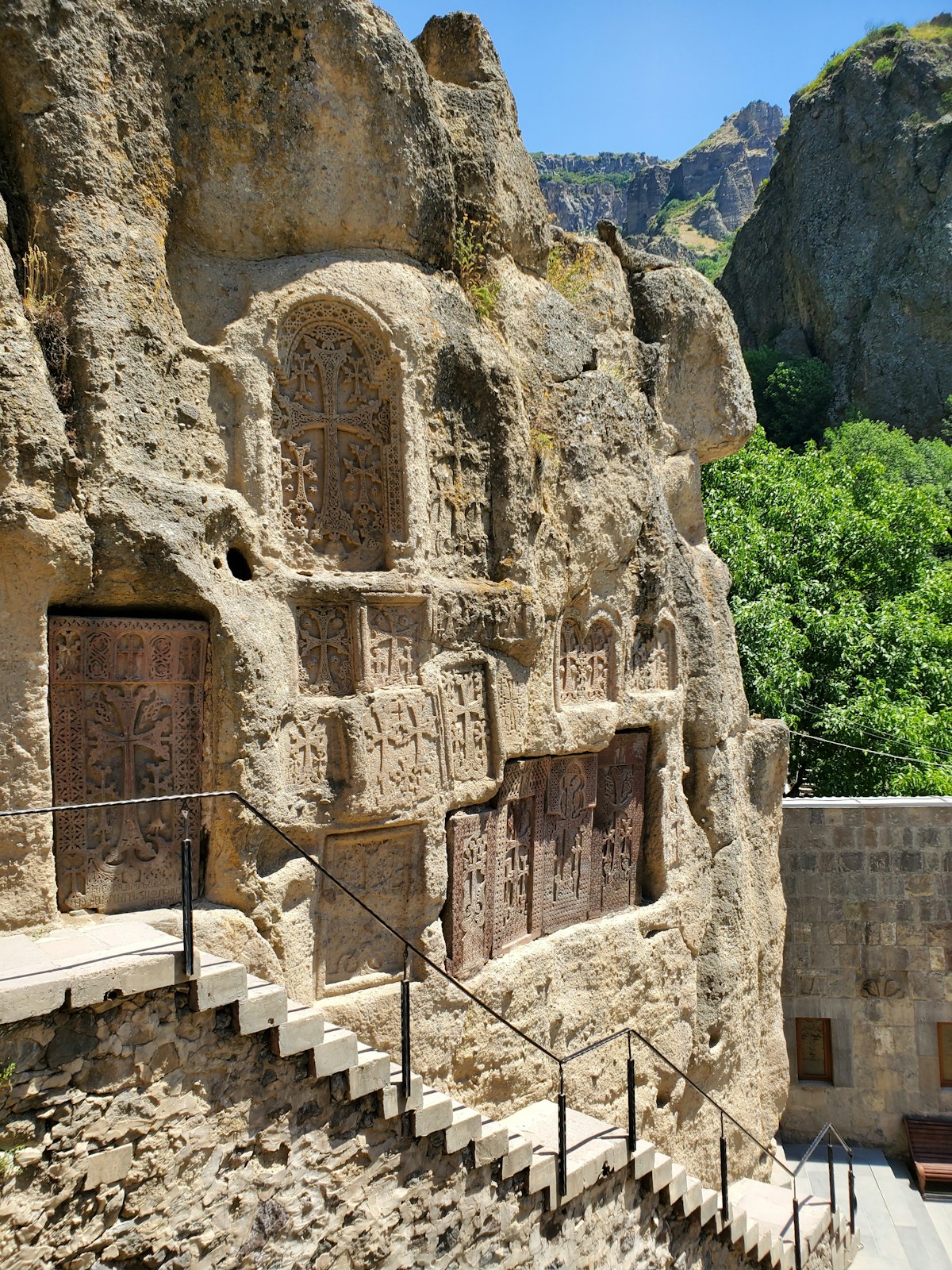
Geghard Monastery: 8 km further up the gorge, UNESCO World Heritage listed. The monastery complex (12th–13th century) combines free-standing churches with cave chapels carved directly into the cliff face - the integration of natural rock and carved architecture is unlike anything else in Armenia. The acoustics inside the cave churches are exceptional; if you’re lucky, you’ll hear local singers demonstrating them. Entry free. The walk up the gorge from the car park takes about 10 minutes.
Combining both sites: Most visitors do Garni first (30–40 minutes), then drive up to Geghard (1 hour minimum, longer if you explore the full complex). A taxi waiting between both sites is the most efficient option.
For a guided Garni and Geghard tour from Yerevan, expect to spend around 4–5 hours total including travel time.
Khor Virap Monastery (40 km south)
Khor Virap is the single most photographed location in Armenia and one of the most powerful visual combinations in the South Caucasus: a medieval monastery standing on the flat Ararat plain, directly in front of snow-capped Mount Ararat across the Turkish border.
Getting there: No reliable public transport directly to Khor Virap. A private taxi from central Yerevan is approximately AMD 6,000–10,000 return (including 1–2 hours waiting time) as of 2026. Alternatively, join an organised tour - Khor Virap is frequently combined with Garni/Geghard or Noravank/Areni on full-day circuits.
At the monastery: Khor Virap (meaning “deep pit” in Armenian) is the site where St. Gregory the Illuminator was imprisoned for 13 years before converting King Tiridates III to Christianity in 301 AD - making Armenia the first country in the world to adopt Christianity as a state religion. You can descend into the original pit dungeon via a steep metal ladder (approximately AMD 500 as of 2026 for a candle to light the way). The monastery is still active; services are held regularly.
Photography: The classic shot is from the hilltop behind the monastery looking north toward Ararat. Morning visits (before 10 am) are best - cloud tends to build around the peak through the afternoon, and the morning light falls across the monastery facade from the east. On many days in summer and autumn, Ararat is clearly visible; winter and early spring are the clearest.
For organised options with guides and transport included, see our Khor Virap tours guide or browse Khor Virap day tours on GetYourGuide.
Lake Sevan (60 km east)
Lake Sevan is the largest lake in the Caucasus and the most significant body of water in Armenia - an expanse of deep turquoise water sitting at 1,900 metres above sea level, with the Sevanavank monastery peninsula as its defining sight.
Getting there: Marshrutka from Kilikia bus station in Yerevan to Sevan town, approximately AMD 400–600 as of 2026. Journey 1–1.5 hours. From Sevan town, taxis to Sevanavank (3 km away) cost approximately AMD 1,000–1,500.
Sevanavank Monastery: Built on a peninsula (originally an island - the lake level has dropped significantly over the 20th century due to irrigation) in the 9th century. Two of the original three churches survive. Entry free. Walk up the stone stairway from the lakeside car park. On clear days, views extend across the entire lake. The monastery is photogenic at any season but particularly striking in late September and October when the surrounding trees turn gold.
Lakeside lunch: Sevan town has several fish restaurants serving ishkhan (Armenian word for “prince fish” - Sevan trout, a species unique to the lake). A full portion approximately AMD 3,000–5,000 as of 2026 depending on size. The fish is typically grilled whole or baked with herbs.
Noratus Cemetery: 10 km west of Sevan town, the largest surviving collection of medieval khachkars (Armenian cross-stones) in the world - approximately 900 stones of varying age and condition. Eerie and atmospheric. Entry free.
Swimming: Lake Sevan is cold even in summer - water temperatures rarely exceed 20°C - but swimming is popular with locals and possible from July to mid-September on the southern beaches.
For full details on organised options, see our Lake Sevan tours guide or browse Lake Sevan tours from Yerevan on GetYourGuide.
Noravank Canyon & Areni Wine Village (120 km south)
A full-day trip to one of Armenia’s most scenically striking destinations - a narrow red-rock canyon with a medieval monastery at its end, combined with a visit to the wine heartland of the Vayots Dzor region.
Getting there: No practical public transport to Noravank itself. A private taxi from Yerevan is approximately AMD 15,000–25,000 return as of 2026 (for a full day including waiting time) - agree on the price and all stops before departure. Organised tours are available and cover the same sites: browse Yerevan day tours.
Areni village and winery: The Areni-1 cave near the village contained the oldest-known winemaking facility in the world (c. 4100 BC). Several small wineries now operate around the village offering free tastings - Areni Winery and Old Areni Wine Factory are the most accessible. The indigenous Areni grape produces wines unlike anything grown outside Armenia. Tastings are low-pressure; purchases are welcome but not expected.
Noravank Monastery: 15 km further south through the Amaghu River canyon, walls of red and orange sandstone rising 300 metres above the road. The 13th-century monastery, with its distinctive two-storey church of St. John the Baptist (Surb Karapet) and the elaborate external staircase of the Church of the Holy Mother of God (Surb Astvatsatsin), is considered one of the most architecturally distinguished in Armenia. Entry free.
Mozrov Cave: A large karst cave system en route, though less impressive than similar attractions elsewhere in the region. Skip if time is short.
Budget a full day for the Areni-Noravank-return circuit, leaving Yerevan by 8 am to avoid tour bus overlap at the canyon in late morning. For tour options, prices, and Tatev combo routes, see our Noravank tours guide.
Dilijan (95 km north)
Dilijan is a small mountain resort town at 1,450 metres altitude in the Tavush region, known for pine forest hiking, the restored old quarter, and a monastic circuit.
Getting there: Marshrutka from Kilikia bus station, approximately AMD 700–900 each way as of 2026. Journey 1.5–2 hours.
Old quarter (Sharambeyan Street): A restored row of 19th-century craftsmen’s workshops and houses, now converted to artisan studios, small restaurants, and craft shops. More attractive than similar reconstructions elsewhere.
Haghartsin Monastery: 18 km east of Dilijan - a 12th–13th-century monastic complex in dense forest, considered one of the most peaceful and atmospheric in Armenia. Taxi from Dilijan approximately AMD 3,000–5,000 return. Entry free.
Hiking: Trails into the Dilijan National Park are accessible from the town. The most popular short hike takes about 2 hours through pine and beech forest to a ridge viewpoint.
Lake Parz: A small mountain lake 7 km from Dilijan, reachable by taxi or on foot. Pleasant for a picnic; some facilities for zip-lining and other activities.
For tour options, guided departures, and Dilijan combo routes, see our Dilijan tours guide.
Tsaghkadzor (50 km north)
A mountain resort town known for skiing in winter and cable car access to alpine meadows in summer. With a medieval monastery and easy access from Yerevan, it’s a good half-day option.
Getting there: Marshrutka from Kilikia bus station, approximately AMD 500–700 each way as of 2026. Journey about 1 hour.
Kecharis Monastery: 12th–13th-century complex on the edge of town. Entry free. Three churches and a gavit (antechamber) in good condition; khachkars throughout. Quiet outside weekends.
Cable car and skiing: In winter, the Tsaghkadzor ski resort has 27 km of runs and a day lift pass approximately AMD 8,000–12,000 as of 2026. In summer, the cable car (approximately AMD 2,000–3,000 return as of 2026) runs to 2,819 metres, with views across the Hrazdan valley and hiking access to the alpine zone above the treeline.
Etchmiadzin & Zvartnots (20–23 km west)
Armenia’s spiritual capital and the seat of the Armenian Apostolic Church, Etchmiadzin is an easy half-day from Yerevan. The UNESCO-listed cathedral complex includes the Mother Cathedral (301–303 AD, possibly the oldest in the world built as a national church), the churches of St Hripsime and St Gayane, and the Etchmiadzin Museum (Holy Lance, illuminated manuscripts, sacred relics). Three kilometres away, the ruins of Zvartnots Cathedral offer one of the most dramatic architectural fragments in the Caucasus. For full details, see our Etchmiadzin visitor guide.
Getting there: Marshrutka from Kilikia bus station to Vagharshapat (Etchmiadzin), approximately AMD 300 per person, journey 30 minutes as of 2026. For a fully structured plan with timings for Etchmiadzin, Zvartnots, and Khor Virap in a single day, see our Etchmiadzin day trip itinerary.
Haghpat & Sanahin Monasteries (185 km north)
Two UNESCO-listed monastery complexes in the Debed Canyon - Haghpat (hilltop, 10th century) and Sanahin (denser, with an unusual 10th-century academy building). The canyon is spectacular in its own right. A full day from Yerevan, or a logical stop if travelling to or from Tbilisi (the monasteries are only 90 km from the Georgian capital). For detailed visiting information, see our Haghpat and Sanahin guide.
Getting there: Marshrutka from Yerevan’s Northern Bus Station to Alaverdi, approximately AMD 2,000–2,500, journey 3 hours. Local taxis from Alaverdi serve both monastery sites.
Tatev Monastery (270 km south - long full day or overnight)
Tatev is in the deep south of Armenia near the town of Goris, roughly 5 hours by car from Yerevan. It can be done as a very long day trip with a pre-dawn start, but most travellers prefer to combine it with an overnight in Goris or include it on a multi-day southern circuit.
Getting there: No public transport to Tatev itself. Private car or organised tour from Yerevan; approximately AMD 30,000–60,000 for a full-day private car depending on route and operator. Some tours leave at 6–7 am to make the day manageable.
Wings of Tatev cable car: The 5.7 km reversible aerial tramway descending from the Goris plateau to Tatev Monastery. Entry approximately AMD 3,500–5,000 return as of 2026. The lower section of the ride crosses the Vorotan River gorge - 320 metres above the canyon floor. The ride takes about 12 minutes each way. See the current ticketing at wingoftatev.am.
Tatev Monastery itself: A 9th–13th century complex perched above a dramatic basalt gorge. The main church, gavit, mausoleum, and oil press are all intact. One of the most architecturally complete and least restored monasteries in Armenia.
For a structured approach to the south, see our 7-day south Armenia itinerary.
Book a Day Trip from Yerevan Online: Prices at a Glance
The tours below are bookable through GetYourGuide with free cancellation. All prices per person for shared group tours, approximate as of 2026 (AMD converted at approximately 400 AMD per USD).
| Tour | Distance | Duration | USD | AMD | Key Stops |
|---|---|---|---|---|---|
| Garni Temple, Symphony of Stones, Geghard & Lavash Baking | 40 km | 6 hrs | from $27 pp | ~10,800 AMD | Hellenistic temple, basalt gorge, cave monastery, lavash demo |
| Lake Sevan, Dilijan & Ancient Monasteries | 100 km | 10 hrs | from $31 pp | ~12,400 AMD | Sevanavank, Haghartsin, Goshavank, Lake Parz forest |
| Khor Virap, Noravank & Areni Wine Tasting | 130 km | 8–9 hrs | from $37 pp | ~14,800 AMD | Mt Ararat view, red canyon, winery, Areni cave |
| Tatev Monastery & Wings of Tatev Cable Car | 270 km | 13–14 hrs | from $73 pp | ~29,200 AMD | Cable car, Khor Virap, Noravank, wine tasting |
| Private Garni & Geghard Tour | 40 km | 6 hrs | from $90 pp | ~36,000 AMD | Same circuit with private guide and vehicle |
| Full-Day Private Tatev Tour | 270 km | 13–14 hrs | from $235 pp | ~94,000 AMD | Hotel pickup, historian guide, lunch, cable car included |
Private tours allow you to control departure time — important for Khor Virap’s Ararat view and Geghard’s morning light. Group tour prices exclude entrance fees and meals.
[Browse all day trips from Yerevan on GetYourGuide →](/go/tours-yerevan/)
Practical Notes
- Private taxi vs. marshrutka: For most day trips, a private taxi gives better flexibility and avoids the uncertainty of marshrutka schedules - particularly for Garni/Geghard and Khor Virap. Negotiate the price, route, and waiting time before departure. Approximately AMD 15,000–25,000 for a full day’s private hire (Yerevan centre and back) is a reasonable baseline as of 2026. For multi-stop circuits — Khor Virap + Noravank in one day, or any route combining three or more sites — GetTransfer lets you specify your exact itinerary and receive competing bids from local drivers, which can produce better pricing than negotiating at the kerb, especially for groups.
- Booking guided tours: GetYourGuide tours from Yerevan offer vetted English-speaking guides for the main circuits. Useful for first visits where context adds significantly to the experience.
- Entry fees: Most Armenian monasteries and temples charge entry, but amounts are modest - budget AMD 5,000–10,000 per day total for sites.
- Best season: April–June and September–October. July and August are hot in the lower valleys (Khor Virap and Garni are on the hot, flat Ararat plain) - start early. Lake Sevan and Dilijan are cooler and more pleasant in summer due to altitude.
For planning your time in Yerevan itself, see our Yerevan destination guide and the 5-day central Armenia itinerary.
Travelling soon? Check our Armenia last-minute tours for confirmed availability and instant booking.