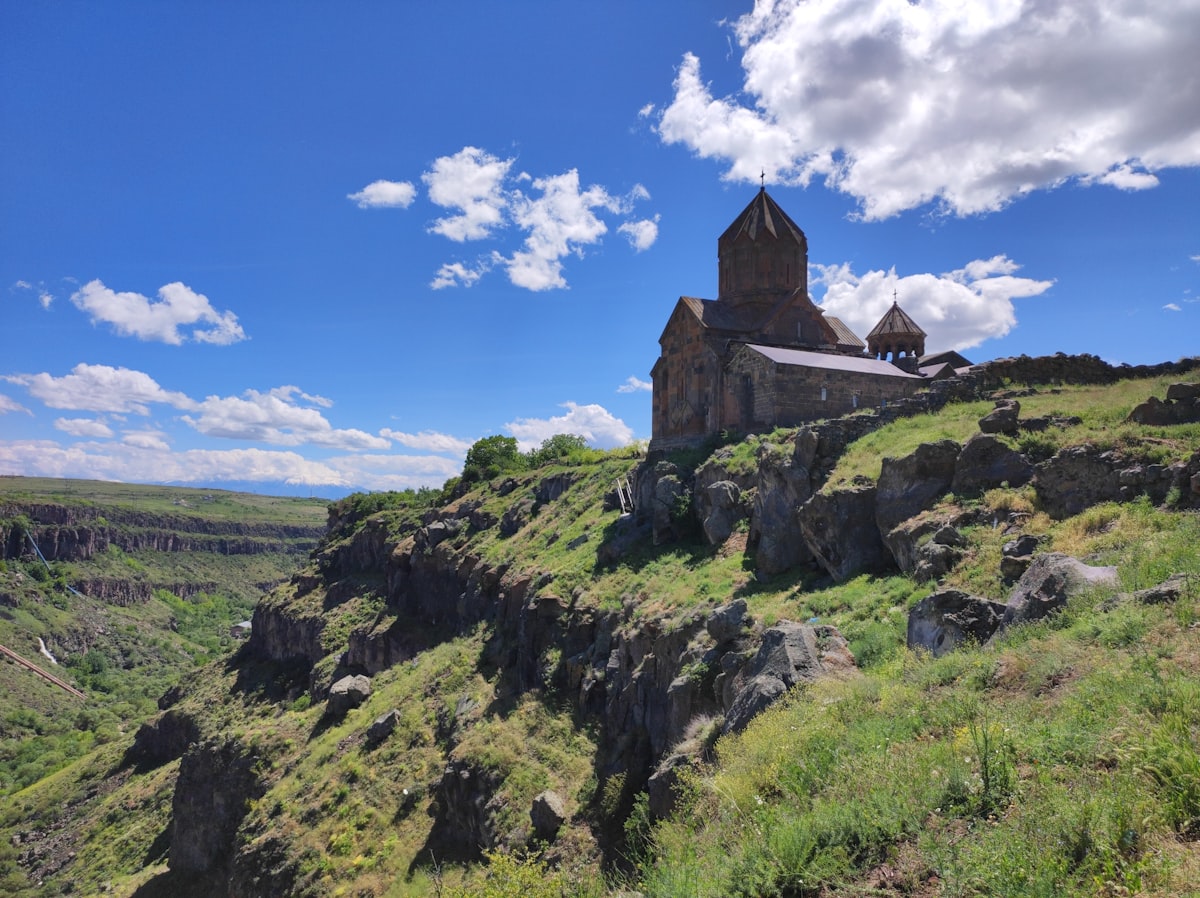
Two walled monastery complexes sit in the Debed Canyon of northern Armenia, separated by just 10 km of road but very different in character. Haghpat is the more theatrical of the pair - a hilltop fortress-monastery with commanding views. Sanahin is denser, its courtyards connected by low passages and its carved stone work among the most intricate in Armenia. Both were designated UNESCO World Heritage Sites in 1996 and together form one of the most rewarding excursions in the country. The canyon makes an excellent overnight stop on an Armenia road trip heading north toward the Georgian border.
Historical Background
The Debed Canyon monasteries were founded during the Bagratid dynasty, the medieval Armenian royal house that rebuilt Armenian political power after centuries of Arab and Byzantine pressure. Sanahin was established around 966 AD; Haghpat followed a few years later, formally consecrated in 976 AD. Both received royal patronage from Queen Khosrovanuysh, wife of King Ashot III, and from the Kiurikian princes who ruled the northern territories.
The name Sanahin derives from an Armenian phrase meaning “older than that one” - a reference, it is said, to a sibling rivalry between the two complexes over which was founded first. Whether true or apocryphal, the story captures the competitive energy that produced two exceptional buildings within a short distance of each other.
Both monasteries functioned not only as religious centres but as intellectual institutions. Sanahin’s scriptorium was one of the most productive in medieval Armenia, copying manuscripts that survive in the Matenadaran collection in Yerevan. The 10th-century scholar Anania Sanahetsi is credited with founding Armenia’s first university here.
The complexes survived successive waves of invasion - Seljuk, Mongol, and Persian - though not without damage. Sanahin was shaken by an earthquake in 1988 that killed more than 25,000 people in the nearby city of Spitak. Restoration work has continued since; parts of the complex remain under repair as of 2026.
Architecture Highlights
Haghpat Monastery
Haghpat’s main church, the Cathedral of Surb Nishan (Church of the Holy Cross), was completed in 991 AD. It follows the cross-dome form typical of Armenian religious architecture: a central drum and conical spire rising above an octagonal drum, flanked by blind arcading on the exterior walls. The interior is plain and dimly lit, concentrating attention on the carved khachkars (cross-stones) embedded in the walls.
The gavit (narthex) attached to the west end of the cathedral is architecturally distinctive: a broad, square hall with a central opening in the roof designed to let in light and air. The intersecting stone ribs forming the ceiling are an Armenian engineering solution to spanning a wide space without a central pillar - a technique developed here in the 12th–13th centuries.
The bell tower (Ժamkoch), separate from the main church, stands at the edge of the monastery compound over a sheer cliff. Built in 1245, it combines an archway functioning as the monastery entrance with a belfry above - a common arrangement in Caucasian medieval architecture.
Amenaprkich (All-Saviour) Church (13th century) stands within the compound and features an unusual carved tympanum above the west door depicting the Deesis - Christ in Majesty flanked by the Virgin and John the Baptist - in unusually expressive low relief.
Memorial steles and khachkars are scattered throughout the compound. The carved stone traditions visible here - interlaced vine scrolls, geometric borders, and the distinctive Armenian cross form - reached their apex in the 12th–14th centuries. Several individual khachkars at Haghpat are considered masterworks of the type.
Sanahin Monastery
Sanahin is more compact than Haghpat and its buildings are more tightly clustered. The main church, Surb Amenaprkitch (All-Saviour), dates to the 10th century and has been modified repeatedly. Adjoining it are two gavits connected by internal passages, a library building, and a funerary chapel containing the tombs of Kiurikian princes.
The Academy building is the most unusual structure in the complex - a columned hall with a reading shelf at eye height running along three walls, designed for studying manuscripts. It has no parallel in other Armenian religious architecture. The roof has partially collapsed but the essential form is clear.
The Bridge of Sanahin, a short walk from the monastery itself, was built in 1195 and spans the Debed River. Though not part of the monastic complex, it is worth seeing: a single-span stone arch with carved decorations at the keystones, remarkably intact after more than 800 years.
Entry and Opening Hours
Both sites are open to visitors throughout the year. There is no formal entrance fee charged at either complex as of 2026, though donations are welcomed at the monastery churches. Dress modestly: shoulders and knees covered. Scarves are sometimes available at the entrance of Haghpat church for visitors who need them.
Haghpat: Open daily, approximately sunrise to sunset. The monastery caretaker is typically present 9am–5pm. No guided tour infrastructure; information boards in Armenian and partial English.
Sanahin: Same hours. The UNESCO World Heritage status has prompted some additional signage in recent years. A small museum adjacent to the monastery complex (verify current opening status before visiting) displays carved stone fragments from the site.
Getting There
From Yerevan
The distance from Yerevan to the Alaverdi area (the nearest town to both monasteries) is approximately 185 km. Journey time by car is approximately 2.5–3 hours via the M6 highway north through the Debed Canyon.
By marshrutka: Regular minibuses run from Yerevan’s Northern Bus Station to Alaverdi. Departures approximately every hour from early morning. Fare approximately AMD 2,000–2,500 (roughly USD 5–6). Journey time approximately 3 hours. From Alaverdi town, local taxis serve both monasteries; negotiate a fare for visiting both sites. Expect to pay approximately AMD 5,000–8,000 (roughly USD 13–20) for a round trip taking in both, as of 2026.
By tour from Yerevan: Several operators run day tours combining Haghpat, Sanahin, and the nearby Akhtala Monastery (a third site in the canyon, with well-preserved Byzantine-style frescoes). Prices approximately AMD 20,000–35,000 per person (roughly USD 51–90) including transport and a guide as of 2026.
Self-drive: The road is straightforward, following the canyon. Parking is available near both monastery entrances. Plan for a full day: driving time plus 1.5–2 hours at each site.
From Tbilisi, Georgia
Haghpat and Sanahin are approximately 90 km south of Tbilisi by road, making them the most accessible of Armenia’s major monastery complexes from the Georgian capital. The border crossing at Bagratashen–Sadakhlo is the nearest point of entry. The drive from Tbilisi city centre takes approximately 1.5–2 hours depending on border wait times.
Several Tbilisi-based tour operators include Haghpat and Sanahin on Armenia day trips. For independent travellers, marshrutkas run from Tbilisi’s Didube bus station to Sadakhlo (AMD/GEL interchangeable in the border zone); continue by local taxi to Alaverdi from the Armenian side.
Border practicalities: The Bagratashen–Sadakhlo crossing is open 24 hours. Most nationalities can cross without a pre-arranged visa on either side. Carry sufficient Armenian drams for the day; ATMs exist in Alaverdi town but are not always reliable.
Combining Both Sites
Most visitors cover both monasteries in a single day. The logical sequence depends on arrival direction:
- From Yerevan: Haghpat first (the road passes through Alaverdi and Haghpat is slightly further south), then Sanahin on the return
- From Tbilisi: Sanahin first (it sits just above Alaverdi town), then Haghpat
Allow at least 1.5 hours at each site. A lunch break at one of the small restaurants in Alaverdi town adds no more than 30 minutes to the total.
The canyon itself is part of the experience. The Debed River has carved a dramatic gorge through the basalt plateau; the monasteries were sited on its edges deliberately, combining defensive position with the symbolic resonance of height. The view from Haghpat’s bell tower across the canyon and the forested ridges beyond repays the journey on its own terms. For a self-drive route through the full canyon with stop-by-stop directions, see our Debed Canyon driving guide.
Practical Notes
Crowds: Both sites attract significant visitor numbers in summer. Morning visits (before 11am) are quieter. Late afternoon light is good for photography but coincides with tour group arrivals.
Photography: No restrictions inside the churches as of 2026. Use a wide-angle lens if possible - the gavit interiors are difficult to capture with a standard phone camera.
Nearby sites: Akhtala Monastery (25 km north of Haghpat on the M6) has 13th-century frescoes in relatively good condition - one of the few examples of painted interior decoration surviving in an Armenian religious building. Odun is a further stop along the canyon with a riverside gorge and castle ruins. The canyon also pairs well with Dilijan further south, where the forested national park and its own monasteries (Haghartsin, Goshavank) make a natural continuation.
Accommodation: Alaverdi town has basic guesthouse and hotel options for those wishing to overnight rather than day-trip. A homestay in Haghpat village, within walking distance of the monastery, gives the quietest experience; prices approximately AMD 10,000–15,000 per person per night (roughly USD 25–38) including dinner as of 2026.
Both monasteries are included on many guided tours departing Yerevan. Independent visitors covering the Debed Canyon circuit will find car hire the most practical option - the round trip from Yerevan is around 300 km.
See Also
- Armenia Road Trip - an itinerary that includes the Debed Canyon on the northern leg
- Dilijan - the forested park town an hour south of the canyon
- Cycling in Armenia - the Debed Canyon is one of the best multi-day cycling routes in the country
- Where to Stay in Alaverdi - accommodation options in Alaverdi and the Debed Canyon for those overnighting rather than day-tripping
- Day Trips from Yerevan - how to reach Haghpat and Sanahin as a day trip, with transport options and timings