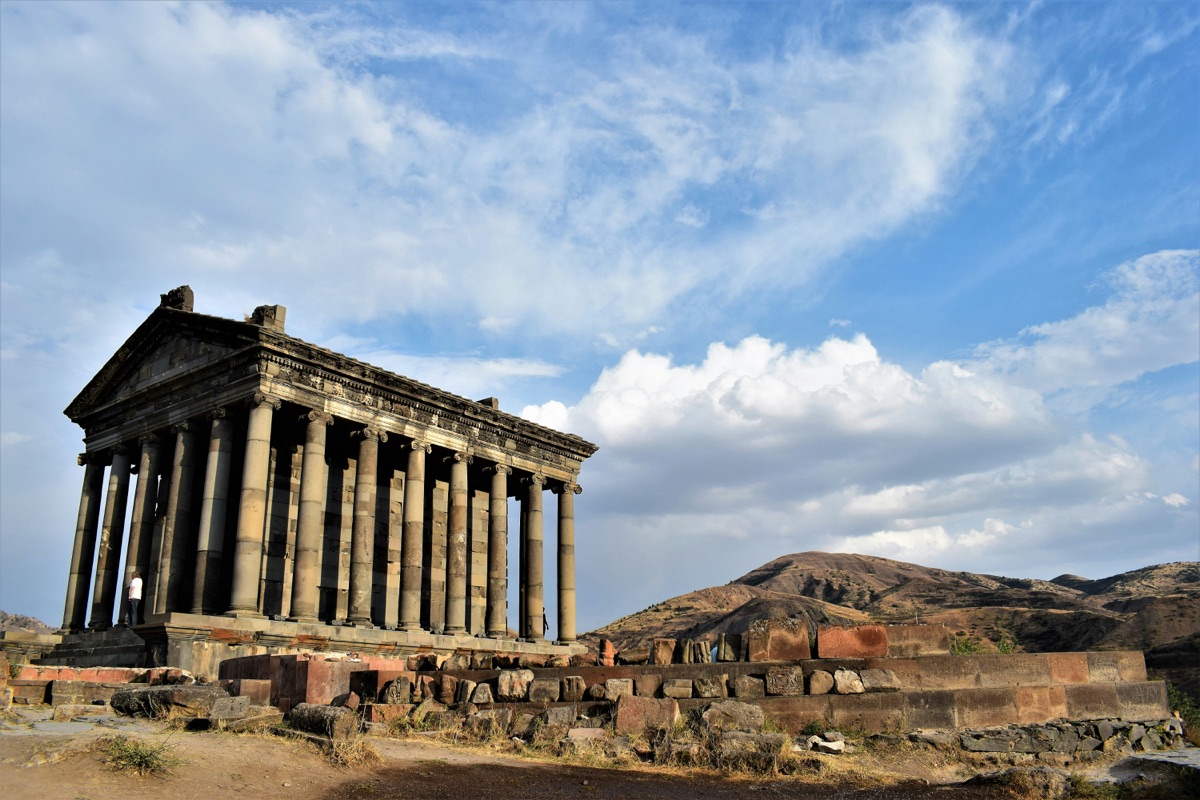
Garni Temple is the only standing Hellenistic-style monument in Armenia and the sole pre-Christian pagan temple to have survived the country’s conversion to Christianity in 301 AD. Built in the 1st century AD under the Arsacid king Tiridates I, it stands on a triangular basalt promontory above the Azat River gorge, 28km east of Yerevan. For the combination of architectural precision, dramatic landscape, and historical weight, Garni is one of the essential stops on any Armenia visit.
Prices listed in this guide are approximate as of 2026.
History and Significance
Armenia entered recorded Roman-era history as a client kingdom oscillating between Rome and Parthia. In 66 AD, the Roman emperor Nero formally invested Tiridates I as king of Armenia in a ceremony in Rome, cementing a period of alliance and cultural exchange. The temple at Garni is generally dated to around 77 AD and reflects Hellenistic architectural influence transmitted through Rome - Ionic order columns, a peristyle plan, a high podium - built from locally quarried basalt rather than marble.
The temple was almost certainly dedicated to Mihr (the Armenian sun deity, cognate with the Persian Mithra), though some scholars argue it may have served as a royal mausoleum or summer palace. After Armenia’s adoption of Christianity, the temple escaped demolition, possibly repurposed as a summer bathhouse for the Arsacid queens. A mosaic floor - the best-surviving evidence of this later use - is partially preserved at the site.
In 1679, a major earthquake brought down the entire structure. Soviet archaeologists undertook a careful reconstruction between 1969 and 1975, using the technique of anastylosis - rebuilding from original fallen stones wherever possible. The result is not a reproduction but a reassembly: approximately 70–80% of the material is original.
The Architecture
The temple sits on a stepped podium of nine tiers, raising it well above the surrounding plateau. The peristyle consists of 24 Ionic columns, six on each short end and eight on each long side (with corner columns shared between counts). Each column stands approximately 6.5 metres tall and is built from drums of grey basalt stacked without mortar - held in place by a system of iron clamps and the precision of the cut. The entablature above carries a carved frieze of rosettes and busts, along with an inscription in Greek that records the construction under Tiridates.
The interior cella is a single rectangular chamber, originally housing the cult statue. The doorway, now restored, features elaborate carved ornament around the frame. The stepped approach to the entrance - the propylon - flanks the temple on the east, where the view opens over the gorge.
What is immediately apparent is how anomalous this building is in the Armenian landscape. Every other major pre-Christian monument in the country has been replaced by a church; Garni alone survived.
The Symphony of Stones (Garni Gorge)
A ten-minute walk from the temple car park brings you to the rim of the Azat River gorge, where the most visually striking natural feature in the Garni area reveals itself. The Symphony of Stones - also called the Basalt Organ - is a wall of columnar basalt rising up to 50 metres above the river. The columns, formed by the slow cooling of lava roughly 40 million years ago, have pentagonal and hexagonal cross-sections packed with such regularity that they appear man-made. Locals named them after a pipe organ; the scale and geometric precision make the comparison accurate.
To reach the columns, take the steep path from the car park down into the gorge - around 20–30 minutes on the descent, and 30–40 minutes back up. Wear shoes with grip; the path involves loose stone in places. The gorge floor is shaded and cooler than the plateau above, with the Azat River running alongside the column wall. This is worth the effort even if the climb back is strenuous.
A second viewpoint from the rim above gives a different perspective and involves no descent - useful if mobility is limited.
Lavash Baking Demonstrations
Several farms and small guesthouses in Garni village (on the approach road from Yerevan) offer lavash baking demonstrations, where visitors watch - and typically participate in - the process of stretching and slapping the thin flatbread onto the inner walls of a tonir (clay oven). Lavash was inscribed on UNESCO’s Representative List of Intangible Cultural Heritage in 2014.
Demonstrations usually include a tasting of fresh lavash with local cheese, herbs, and dried fruits, and last around 30–45 minutes. Costs are typically approximately 2,000–4,000 AMD per person as of 2026, often including a light meal. Booking in advance is recommended in peak season. The community-run Garni Lavash Workshop near the village entrance is the most established option; several guesthouses along the main road offer the same experience more informally.
Entry Fee and Opening Hours
Admission to the temple complex is approximately 1,500 AMD per adult as of 2026; children under 7 enter free. Tickets are sold at the entrance gate. Bring AMD cash - card payment is not reliably available at the site.
Opening hours are approximately 09:00–19:00 from May through October and 10:00–17:00 from November through April. The site is open daily except in unusual circumstances. Arriving by mid-morning allows enough time to see the temple, walk to the gorge viewpoint, and descend to the Symphony of Stones before the afternoon coach groups arrive in force.
Getting There from Yerevan
Garni is 28km east of Yerevan along a well-maintained road through the Azat Valley. The drive takes around 40–50 minutes by car.
Marshrutka (Shared Minibus)
Marshrutka 266 departs from the Gai market area, near Gai metro station (the eastern end of the Yerevan metro). Services run roughly every 30–40 minutes during daylight hours and cost approximately 300 AMD per person as of 2026. Journey time is around 1 hour. The marshrutka terminates at the Garni village entrance, a short walk from the temple. Return marshrutkas depart from the same stop.
Taxi
A taxi from central Yerevan costs approximately 3,000–5,000 AMD each way as of 2026, or 7,000–12,000 AMD for a return trip with waiting time. Agree the price before departing; most drivers recognise the standard Garni–Geghard day trip route. Ride-hailing apps (GG Taxi, Yandex) work in Yerevan and can book this route.
Guided Day Tour
Most Yerevan tour operators run a standard Garni–Geghard day trip combining both sites. Shared tours cost approximately 8,000–15,000 AMD per person as of 2026; private tours from around 30,000 AMD. For a full comparison of transport options, operator recommendations, and a suggested timed itinerary, see our Garni and Geghard day tour guide.
Combining with Geghard Monastery
Geghard Monastery is 10km further up the Azat Valley from Garni, cut into the living rock of the gorge wall. Founded in the 4th century and expanded substantially in the 13th, it contains a series of cave churches carved directly into the cliff face - a combination of free-standing and rock-hewn architecture found nowhere else in Armenia. Entry to Geghard is free.
The Garni–Geghard pairing is the most logical day trip from Yerevan: same road, same direction, natural sequence. Allow 45–60 minutes at each site, plus time for the gorge at Garni if you want it. A lavash demonstration at a village farm on the way back rounds out the day well. For a broader central Armenia route, see our 5-day central Armenia itinerary.
Best Time to Visit
April to June and September to October are the best months for Garni. Spring brings wildflowers to the surrounding plateau and clear mountain light; autumn colours the hills flanking the gorge and the crowds thin from peak summer levels.
July and August are the busiest months. The site is crowded between 10:00 and 15:00 in summer; arriving before 09:30 or after 17:00 avoids the worst of it. The plateau above the gorge has minimal shade, so sun protection and water are essential.
November to March is quieter and the landscape has a raw quality that suits photography. The road remains passable in winter, though the gorge path to the Symphony of Stones can be icy. Some facilities (the lavash farms, a few cafés) close or reduce hours out of season.
What to Wear and Bring
- Footwear with grip - essential for the gorge descent; flip-flops are not suitable
- Sun protection (hat, sunscreen) - the plateau is exposed
- Water - the site café sells drinks but at higher prices
- AMD cash - for entry, the café, and any lavash demonstration
- A light layer - the gorge is noticeably cooler than the plateau above
Where to Eat Near Garni
The site cafe at the temple entrance sells Armenian coffee (approximately 300 AMD), cold drinks, and packaged snacks - adequate for a refreshment break but limited as a meal option. A few stalls near the car park sell dried fruit, local honey, and ceramic souvenirs.
For a proper meal, the Garni village (approximately 1 km from the temple on the main approach road from Yerevan) has several family guesthouses that serve set Armenian lunches. The typical spread includes fresh lavash from the tonir, white gata cheese, herbs and radishes, a seasonal salad, and a khorovats plate. Expect approximately 3,000-5,000 AMD per person including a cold drink. These lunches are served in garden courtyards or shaded terraces; on a clear spring or autumn day they are among the most relaxed eating experiences on the Yerevan day-trip circuit. Guesthouses that run lavash baking demonstrations typically combine the demonstration and a meal for approximately 4,000-6,000 AMD total.
On the highway return toward Yerevan, a cluster of roadside khorovats restaurants operates near the Hrazdan river crossing. These venues - identifiable by smoke from the mangal grills - are busy with Yerevan families at weekends. A full mixed meat plate with lavash, salads, and grilled vegetables costs approximately 4,000-7,000 AMD per person. Cash only at almost all roadside grill spots.
If travelling by marshrutka without a car, the local grocery shops in Garni village sell bread, cheese, and fresh fruit for a simple picnic on the temple promontory, where the basalt gorge provides a natural backdrop.
Practical Tips
- The site car park can fill during peak summer afternoons. If driving, aim to arrive before 10:00 or after 16:00.
- A small café at the entrance sells Armenian coffee, cold drinks, and snacks. A few stalls near the car park sell souvenir ceramics, dried fruit, and local honey.
- Mobile signal is generally good at Garni (Yerevan metro area coverage); it weakens in the gorge.
- Combine Garni with Lake Sevan for a full day heading north-east from Yerevan - Sevan is a further 40km beyond Garni on a different road, making a circular route possible by car.
The most efficient way to visit Garni alongside Geghard is through a guided Garni and Geghard day tour from Yerevan. For Garni Temple tickets and timed entry options, check Tiqets Armenia — useful in peak season when queues build. Driving yourself takes around 40 minutes from central Yerevan - compare car hire rates from Zvartnots Airport.
See Also
- Geghard Monastery - the UNESCO rock-carved monastery 10km beyond Garni, usually visited on the same day trip
- Garni and Geghard Day Tour - transport options, tour operators, and what to budget
- 5-Day Central Armenia Itinerary - a full route including Garni, Geghard, Lake Sevan, and Khor Virap
- Best Time to Visit Armenia - seasonal guide to help plan your visit
- Where to Stay near Garni - accommodation options in Garni village for those overnighting rather than day-tripping