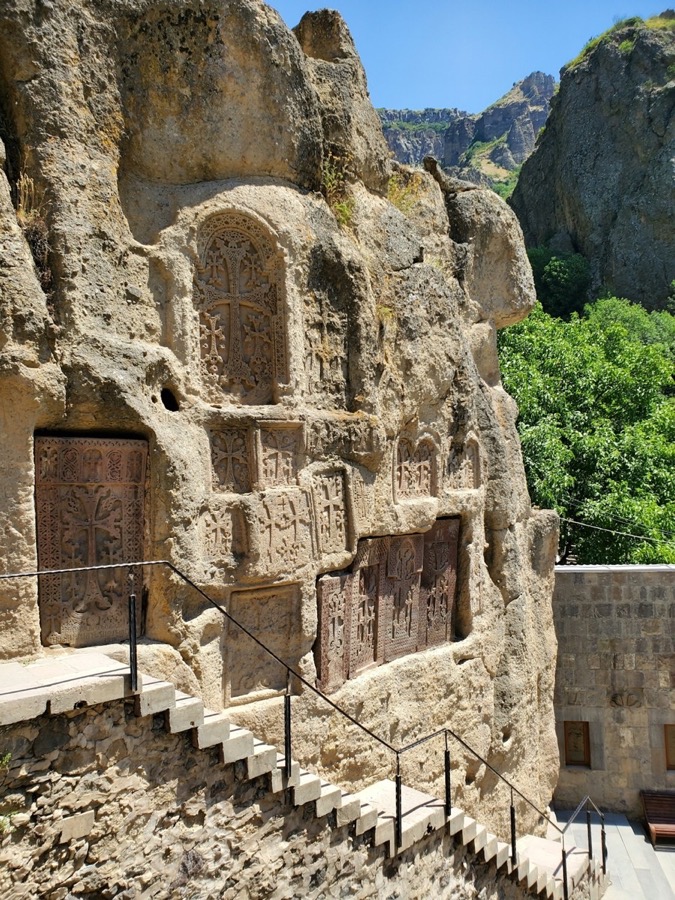
Geghard Monastery - its full name Geghardavank, meaning Monastery of the Spear - is one of the most remarkable medieval buildings in the world. Part free-standing church complex, part cave architecture carved directly from a cliff face of the Azat Valley gorge, it stands 40km east of Yerevan and forms a UNESCO World Heritage Site jointly with the surrounding Upper Azat Valley. For atmosphere, history, and architectural ambition, it is the essential monastery stop in Armenia.
Prices listed in this guide are approximate as of 2026.
History and UNESCO Designation
Tradition holds that a monastery was first established at this site in the 4th century by St. Gregory the Illuminator, the apostle of Armenian Christianity, shortly after Armenia’s conversion in 301 AD. The original foundation gave the gorge its earlier name, Ayrivank - Monastery of the Cave. The current complex was built primarily in the 13th century under the patronage of the Zakarids and later the Proshian princes, who used the site as a family mausoleum and intellectual centre.
The monastery takes its better-known name from the Holy Lance - the geghard in Armenian - the spear said to have pierced Jesus’s side at the Crucifixion. According to Armenian tradition, the relic was brought here by the Apostle Thaddeus (Judas Thaddaeus), who is credited with bringing Christianity to Armenia in the 1st century AD. For centuries the lance was the monastery’s most significant relic; it was eventually transferred to the treasury of Echmiadzin Cathedral, where it is kept today.
UNESCO inscribed the Monastery of Geghard and the Upper Azat Valley as a World Heritage Site in 2000, recognising the exceptional fusion of free-standing and rock-cut architecture, the quality of the medieval stone carvings, and the site’s importance to Armenian Christian heritage.
The Architecture: Free-Standing and Rock-Carved
Geghard’s defining quality is the combination of two construction techniques on a single site.
Katoghike Church (1215)
The main church of the complex is entirely free-standing, built from cut stone on a cruciform plan with a conical drum and dome. The exterior walls are plain by Armenian medieval standards; the interior surprises with deeply carved blind arcading and a series of khachkars - Armenian cross-stones - set into the walls at varying heights. The church was built by the Zakarian princes and is still in active liturgical use.
The First Cave Church (Gavit, 1215–1225)
The gavit (antechamber or narthex) adjoining the main church transitions from free-standing to semi-carved construction. Its ceiling carries a remarkable stalactite vault - a carved stone rosette pattern from which dozens of pendant forms descend, creating a visual ceiling unlike anything else in Armenian religious architecture. Natural light enters from an oculus at the apex.
The Rock-Carved Chambers (mid-13th century)
Further into the cliff, two chambers are entirely carved from the living rock of the gorge wall. The first carved hall served as the Proshian family mausoleum; bas-relief carvings of an eagle clutching a calf and a pair of lions on chains - the heraldic symbols of the Proshians - are cut directly into the stone above the doorway. A second, smaller chamber beyond it reaches deeper into the mountain, with crudely hewn walls and a rough-cut ceiling. The contrast between the polished decorative work of the entrance and the raw rock at the back captures the effort involved in carving an entire room from a cliff face.
Khachkars and Stone Carvings
The walls throughout Geghard carry khachkars - the distinctive Armenian carved steles consisting of an ornate cross above a circular sun or wheel motif, surrounded by interlaced knotwork. Geghard’s examples span several centuries and styles, from simple monastic markers to elaborate compositions where the negative space between the carved elements is as intricate as the stonework itself. Running your eye along any interior wall, the density and variation of the carvings is striking.
The carved wooden doors on the cave church entrances are also exceptional - deep relief carvings of crosses, vines, and geometric patterns, darkened with age, set into door frames cut directly from the rock. These are among the best-preserved examples of Armenian medieval woodcarving.
Choral Performances and Acoustics
Geghard is famous among musicians and visitors for its natural acoustics. The carved cave chambers are essentially stone resonating boxes: a note sung inside the first carved hall sustains for several seconds, creating a natural reverb that no purpose-built concert hall can replicate. Sacred music and the Armenian Apostolic liturgy have been performed here continuously for 800 years, and the acoustics are part of the reason.
Organised choir performances do take place at Geghard, particularly on Armenian Apostolic feast days and during specialist tours. Several Yerevan operators - including Hyur Service and Envoy Hostel Tours - can arrange private performances as part of an extended tour. If you arrive during a service or choir rehearsal, stop and listen: the sound is one of the more affecting experiences any medieval building offers.
The Spring Water Tradition
Just inside the main monastery gate, a natural spring channels into a carved stone basin. Drinking from it is a genuine local tradition - not a tourist performance. Armenian visitors cup their hands under the flow before entering the churches. The water runs cold year-round from the aquifer in the gorge wall. Whether or not the tradition means anything to you, the water itself is worth drinking: clean, cold, and a sensible preparation for the carved chambers beyond.
Entry Fee and Opening Hours
Entry to Geghard is free. There is no ticket gate. A donation box near the entrance contributes to maintenance of the complex.
The site is open approximately 08:00–19:00 in summer (May–October) and 09:00–17:00 in winter (November–April). As an active monastery, services are conducted on Sunday mornings and on feast days - visiting during or just before a service is welcome. Parking at the entrance is free.
Getting There from Yerevan
Geghard is 40km east of Yerevan along the Azat Valley - the same road that passes Garni Temple at the 30km mark.
Marshrutka + Taxi (Budget Option)
Take Marshrutka 266 from Gai market (near Gai metro station) to Garni village for approximately 300 AMD (around 1 hour). From Garni, a local taxi for the remaining 10km to Geghard costs approximately 1,000–2,000 AMD each way as of 2026. Agree the fare and whether the driver will wait. Return marshrutkas from Garni to Yerevan run until early evening.
Taxi from Yerevan
A direct taxi from central Yerevan to Geghard costs approximately 5,000–8,000 AMD each way as of 2026. A return trip with waiting time (enough to see both Garni and Geghard) runs approximately 15,000–25,000 AMD. Ride-hailing apps (GG Taxi, Yandex) work in Yerevan and can book this route; agree the total fare before departing.
Guided Day Tour
The standard Garni–Geghard combination is the most popular day trip sold by Yerevan operators. Shared tours cost approximately 8,000–15,000 AMD per person as of 2026; private tours from around 30,000 AMD. Established options include:
- Envoy Hostel Tours - budget-friendly shared tours, hotel pickup available
- Hyur Service - well-organised shared and private options with knowledgeable guides
- OREX Travel - flexible private tours; price on request
Book at least a day ahead in peak season (May–September).
Photography Tips
- The exterior cave wall: stand back from the entrance to frame the carved wooden doors against the full height of the cliff above. This is the most distinctive composition at the site.
- The stalactite vault in the gavit: use the ambient light from the oculus - supplement with a phone flash only if natural light is insufficient, as flash bleaches the stone texture.
- Morning light: the gorge faces east, so morning sun reaches the monastery facade between roughly 09:00 and 11:30 in summer. By midday the site is in partial shadow.
- Avoiding crowds: tour groups tend to arrive between 10:30 and 14:00. Arriving before 09:30 or after 15:30 gives significantly more room around the cave entrances.
- The gorge approach road: the last 2–3km of the access road runs through a narrow wooded gorge. The view of the cliff face with the monastery complex visible in the rock is worth stopping for.
What to Wear
As an active religious site, shoulders and knees should be covered - scarves are available to borrow near the entrance if needed. The cave chambers are significantly cooler than the outside temperature, even in summer, so a light layer is worth carrying. The surfaces inside the carved chambers are uneven and sometimes slippery where water seeps through the rock. Sensible shoes are essential - sandals without heel support are not suitable for the internal steps.
Combining Geghard with Garni Temple
The 10km between Garni and Geghard is the natural pairing for any visit. Start at Garni Temple - entry 1,500 AMD, the Symphony of Stones gorge walk takes 45–60 minutes - then continue up the valley to Geghard. The two sites cover complementary ground: the pre-Christian pagan and the medieval Christian; the fully reconstructed and the organically grown. For a structured wider itinerary covering central Armenia, see our 5-day Armenia itinerary.
Best Time to Visit
April to June and September to October are the best months. The gorge is at its greenest in spring; autumn colours the wooded valley walls with amber and gold. Summer (July–August) is busy but the site remains manageable if you arrive early. Winter visits are quieter and the snow on the gorge rim gives the carved stone a dramatic quality - the road stays passable in most winters. For a full seasonal breakdown, see our best time to visit Armenia guide.
Book a Garni and Geghard guided tour to cover both sites in a single day - most tours depart Yerevan mid-morning. For skip-the-queue tickets and curated monastery experiences, browse Tiqets Armenia. Self-driving visitors can compare car hire from Yerevan Airport - the road is paved and takes around 50 minutes from the centre.
See Also
- Garni Temple - the pre-Christian pagan temple 10km before Geghard, usually combined on the same day trip
- 5-day Central Armenia Itinerary - a structured route covering Garni, Geghard, Lake Sevan, and Khor Virap
- Day Trips from Yerevan - all the best day excursions from the capital
- Things to Do in Yerevan - city attractions to combine with your monastery day
- Where to Stay near Garni and Geghard - accommodation options for those overnighting in the Azat Valley rather than day-tripping from Yerevan