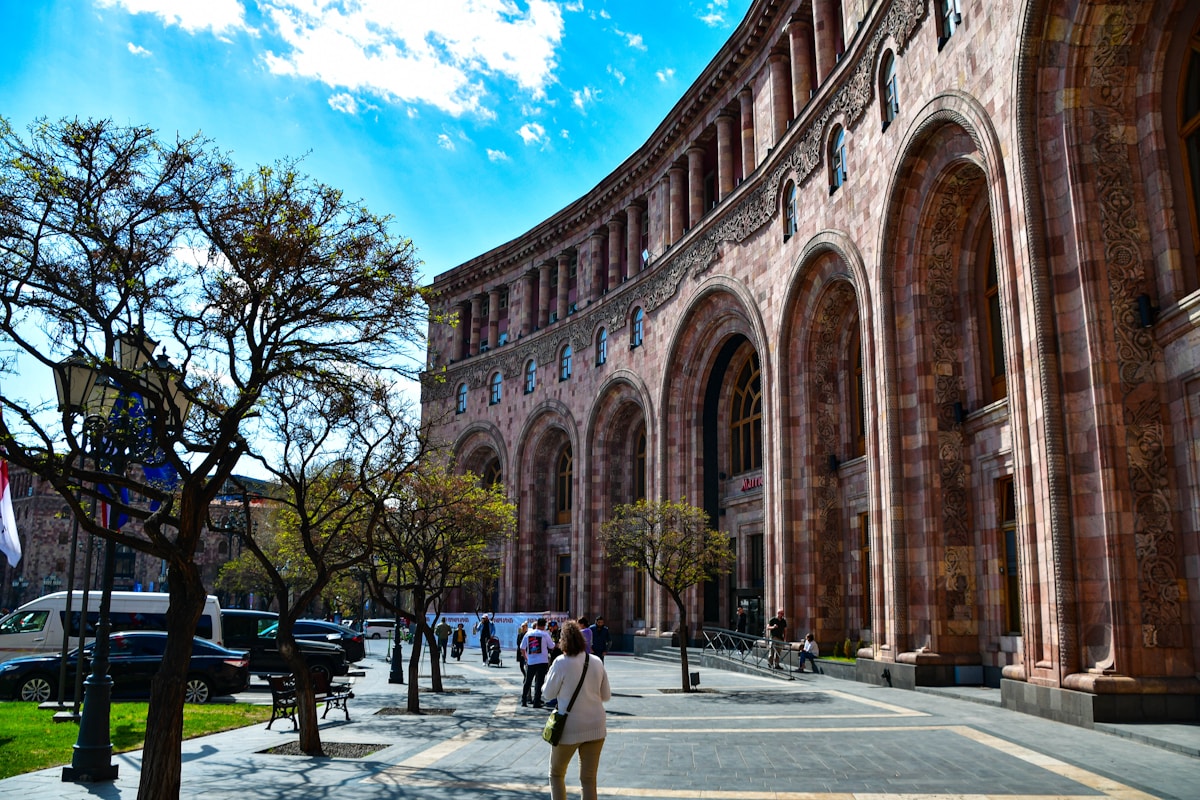
Yerevan is one of the most walkable capitals in the world — and one of the most rewarding on foot. The city’s signature pink tufa stone glows in the afternoon light, the boulevards are wide, and the distance between the best landmarks is short enough to cover in half a day without a taxi or a group tour.
This self-guided walking tour covers the core of the city in roughly 3 to 4 hours. You can stretch it to a full day if you stop for coffee, browse the Vernissage market, or duck into a museum or two. All the navigation tips, entry costs, and café stops are included below.
What to Expect From This Route
Distance: approximately 5 km (3.1 miles)
Duration: 3–4 hours walking, up to 6 hours with museum and café stops
Difficulty: easy — mostly flat, with one notable climb at the Cascade
Best time to go: early morning (before 10am) or late afternoon; summer middays are hot
Start point: Republic Square (Hanrapetutyan Hraparak) — accessible by metro (Republic Square station)
The route runs north from Republic Square through Northern Avenue, takes in the Opera House and Lovers’ Park, climbs the Cascade, then turns south toward Matenadaran and the city’s historic core. You can reverse it if you prefer to start with the uphill section while your legs are fresh.
Stop 1: Republic Square
Every Yerevan walk starts here. Republic Square is the architectural centrepiece of the city — a curved ensemble of salmon-pink travertine government buildings framing a central pool with singing fountains. The fountains run with music on summer evenings (check locally for times, typically 9pm–10pm), but the square is worth visiting at any hour.
Circle the square slowly to take in the Ministry of Foreign Affairs, the National History Museum (entry approximately AMD 1,000/around $2.50), and the Marriott Armenia hotel on the north side. The museum’s ground floor has a permanent collection of prehistoric artefacts from the region — worth an hour if you have it.
Stop 2: Northern Avenue (Hiusisayin Prospekt)
Head north from Republic Square along Northern Avenue, a pedestrianised boulevard lined with cafés, jewellery shops, and outdoor seating. This is Yerevan’s answer to a European promenade — relatively new (completed in 2007), but now firmly embedded in daily life. Good for a coffee stop; the chains and independents both have decent outdoor tables.
Northern Avenue connects directly to Freedom Square (Azatutyun Hraparak) and the opera quarter.
Stop 3: Yerevan Opera House and Lovers’ Park
The circular Yerevan Opera House (formally the Armenian National Academic Theatre of Opera and Ballet, named after Alexander Spendiaryan) sits at the top of Northern Avenue. The building dates from 1933 and is a striking example of Soviet-era classicism with Armenian decorative motifs. Check the box office for evening performances — tickets are affordable (from around AMD 3,000–8,000).
Behind the opera, Lovers’ Park (Spitak Ashkharh — “White World”) is a peaceful garden with fountains, sculptures, and benches. Families and couples use it throughout the day. It’s a good picnic spot if you’ve picked up bread and fruit from the Central Market earlier.
Stop 4: The Cascade Complex
The Cascade is Yerevan’s most distinctive landmark — a giant stepped fountain complex cut into the hillside that connects the city centre to the hilltop Haghtanak Park above. The outdoor staircase is free and open at all hours. The interior contains the Cafesjian Center for the Arts (free entry to most galleries), with a permanent collection of modern and contemporary art spread across five levels.
The climb to the top takes around 15–20 minutes at a relaxed pace. At the summit you get panoramic views south across the city, and on clear days the full profile of Mount Ararat — technically in Turkey but visible in its entirety from Yerevan — dominates the horizon.
The sculptures along the lower terraces and surrounding streets include works by Fernando Botero (the large bronze cats are his). Grab a coffee at one of the terrace cafés before heading back down.
Stop 5: Matenadaran (Mesrop Mashtots Institute of Ancient Manuscripts)
Walk south along Mashtots Avenue — named for the 5th-century monk who invented the Armenian alphabet — to reach the Matenadaran, one of the world’s great manuscript repositories. The building sits at the top of the avenue on a raised terrace, flanked by statues of Armenian scholars.
Entry costs approximately AMD 3,000 (around $7.50) for adults. The collection includes over 23,000 manuscripts spanning theology, science, mathematics, and medicine — some dating back to the 9th century. The main hall has rotating exhibitions with remarkable illuminated manuscripts on display. Allow 45–60 minutes.
Stop 6: Mashtots Avenue and the Blue Mosque
Continuing south down Mashtots Avenue brings you to the heart of the old city commercial district. The Blue Mosque (Gök Jami), a few blocks east, is the only surviving mosque in Yerevan and dates from the 18th century. It was restored in the 1990s and is open to visitors (dress modestly; entry free). The tilework in the interior courtyard is exceptional.
Stop 7: Vernissage Market
End the walk at the Vernissage open-air market, operating on weekends near the History Museum. Stalls sell Armenian woodwork, pottery, carpets, jewellery, Soviet-era objects, and lacework. It’s not a tourist trap — locals buy here too. Good for picking up a small piece of Armenian tufa stone carving or a backgammon set.
Practical Tips
Navigation: Google Maps works well in Yerevan; download the offline map before you go. A local SIM card makes navigation much easier — see /go/sim-armenia for the best eSIM options for Armenia.
Money: Most cafés and restaurants accept cards, but the Vernissage and smaller museums are cash-only. ATMs are plentiful on Mashtots Avenue and near Republic Square.
Water: Carry water, especially in summer. The pink tufa city absorbs and radiates heat. Yerevan tap water is safe to drink.
Shoes: The Cascade stairs are steep; wear comfortable, closed shoes. The rest of the route is pavement.
Travel insurance: If you’re visiting as part of a broader Caucasus trip, check cover for the region — /go/insurance-armenia has options suited to Armenia travel.
Café and Food Stops on the Route
The route passes some of Yerevan’s best café strips. For a full guide to where to eat on and around the walk, our Yerevan food tours guide covers specific restaurants, dolma specialists, and lavash bakeries worth building a detour around.
Quick stops on the route itself:
- Northern Avenue — multiple independent cafés with outdoor seating; try Armenian coffee (sırçeli) rather than espresso
- Cascade terrace cafés — views come included
- Tumanyan Street (parallel to Northern Avenue) — quieter, with a handful of well-regarded breakfast spots
Extending the Walk Into a Full Day
If you want more, a few additions work well:
- Tsitsernakaberd Genocide Memorial — about 3 km west of the Cascade; best reached by taxi (AMD 600–800) or the 18 bus. One of the most important sites in the country; allow 45–60 minutes.
- ARARAT Brandy Company — guided tastings available for the Yerevan Brandy Company / ARARAT distillery just south of Republic Square; book ahead. Free to visit the grounds, tasting packages from approximately AMD 5,000.
For a full list of what to do beyond the walk, see our things to do in Yerevan guide. And if you’re exploring beyond the city centre, our Yerevan neighbourhoods guide covers Norq, Arabkir, Shengavit, and the other districts worth walking once you’ve done the core route.
Prefer a Guided Tour?
Self-guided is free and flexible, but if you want expert context on the history — particularly the Soviet period, Armenian independence, and the symbolism embedded in the architecture — a guided city tour adds a great deal. See options below, most of which depart from Republic Square.
Where to stay: For accommodation near the walking route, /go/stay-yerevan covers hotels within walking distance of Republic Square and the Cascade.