Armenia’s temporary visa exemption for nationals of 113 countries expired on 1 July 2026 as scheduled. The programme ran from 1 January to 1 July 2026 and allowed nationals of those countries who held a valid residence permit issued by the United States, the European Union or Schengen Area, the UAE, Bahrain, Qatar, Saudi Arabia, Kuwait or Oman to enter Armenia visa-free for stays of up to 180 days within a 12-month period.
From 2 July 2026, standard visa requirements apply. Nationals already in Armenia under the exemption were not affected mid-stay - the change applied only to new arrivals from 2 July onward.
Who the scheme applied to - and who it didn’t
This programme was specifically for nationalities that would normally require a visa to enter Armenia but who held a current residence permit from a qualifying country. The qualifying residency issuers are: the United States, any EU member state, any Schengen Area country (including non-EU Schengen members such as Switzerland, Norway and Iceland), the United Arab Emirates, Bahrain, Qatar, Saudi Arabia, Kuwait and Oman. The residence permit must be a physical card - digital or provisional documents are not accepted - and must remain valid for at least six months beyond the date of entry into Armenia.
Nationals of the United States, all 27 EU member states, the United Kingdom, Canada, Australia, New Zealand, Japan and South Korea can already enter Armenia visa-free for up to 180 days per year under standard bilateral agreements - for those nationalities, the temporary scheme added nothing new.
The scheme was most valuable for nationalities that fall outside those standard visa-free agreements but who live and work in the US, Europe or the Gulf - for example, citizens of countries in South and Southeast Asia or parts of Africa who hold a valid EU residence card or a US green card.
What changed after 1 July
From 2 July 2026, residents of visa-required nationalities who do not qualify for standard visa-free access must apply for an Armenian e-visa before travel. A 21-day single-entry e-visa costs approximately USD 6 (around AMD 3,000), while a 120-day single-entry e-visa costs approximately USD 38 (around AMD 15,000), as of 2026. Applications are processed online through the official Armenian e-visa portal at evisa.mfa.am. The Armenian government had left open the possibility of extending the scheme, but no extension was announced before the 1 July deadline.
Armenia’s EU visa liberalization process
Running alongside the temporary entry scheme, Armenia is advancing a longer-term process toward full EU visa liberalization. Armenian Prime Minister Nikol Pashinyan stated on 24 May 2026 that Armenia will achieve visa-free travel with the EU within two years, citing 500% growth in Armenians seeking to visit EU countries between 2018 and 2025 as the impetus for accelerating the process.
The Armenia–EU Visa Liberalization Dialogue opened formally in September 2024. The European Commission submitted a Visa Liberalization Action Plan (VLAP) containing 74 mandatory benchmarks to Yerevan in November 2025, covering four reform pillars: document security, border and migration management, public order and security, and fundamental rights. That plan was delivered personally to Armenia’s Minister of Internal Affairs at the inaugural Armenia-EU Summit in Yerevan on 5 May 2026, in the presence of PM Pashinyan, European Council President António Costa, and European Commission President Ursula von der Leyen.
The European Commission published its first formal progress report on 13 May 2026, recording that Armenia has made “good progress” across all four pillars. Specific milestones include: a new State Population Register law adopted in July 2025; a public-private partnership to modernize Armenia’s national biometric identification system; Parliament’s vote on 12 May 2026 to mandate ICAO Standard 9303-compliant biometric passports and ID cards (storing facial recognition data and fingerprints); an Integrated Border Management Strategy for 2026–2029 under development; a new Crime Prevention Strategy for 2026–2033; and a draft anti-discrimination law aligned with EU standards. Additional EU assessment missions to Armenia are expected in the coming months.
Under the new ID law, all citizens aged 16 and above will be required to hold a biometric ID card; those aged 6–16 may obtain one voluntarily; children under 6 continue to use birth certificates. All new passports will enable automatic e-gate processing at European airports. Issuance of the new documents is expected to begin in the second half of 2026, according to Minister of Internal Affairs Arpine Sargsyan. Existing passports and ID cards remain valid until their expiry dates.
Visitor numbers and the travel case
Tourism arrivals to Armenia rose 17% year-on-year in the first quarter of 2026, with 172,705 tourists recorded in April 2026 alone - up 39.6% year-on-year. The country consistently ranks among the most affordable destinations in the Caucasus region.
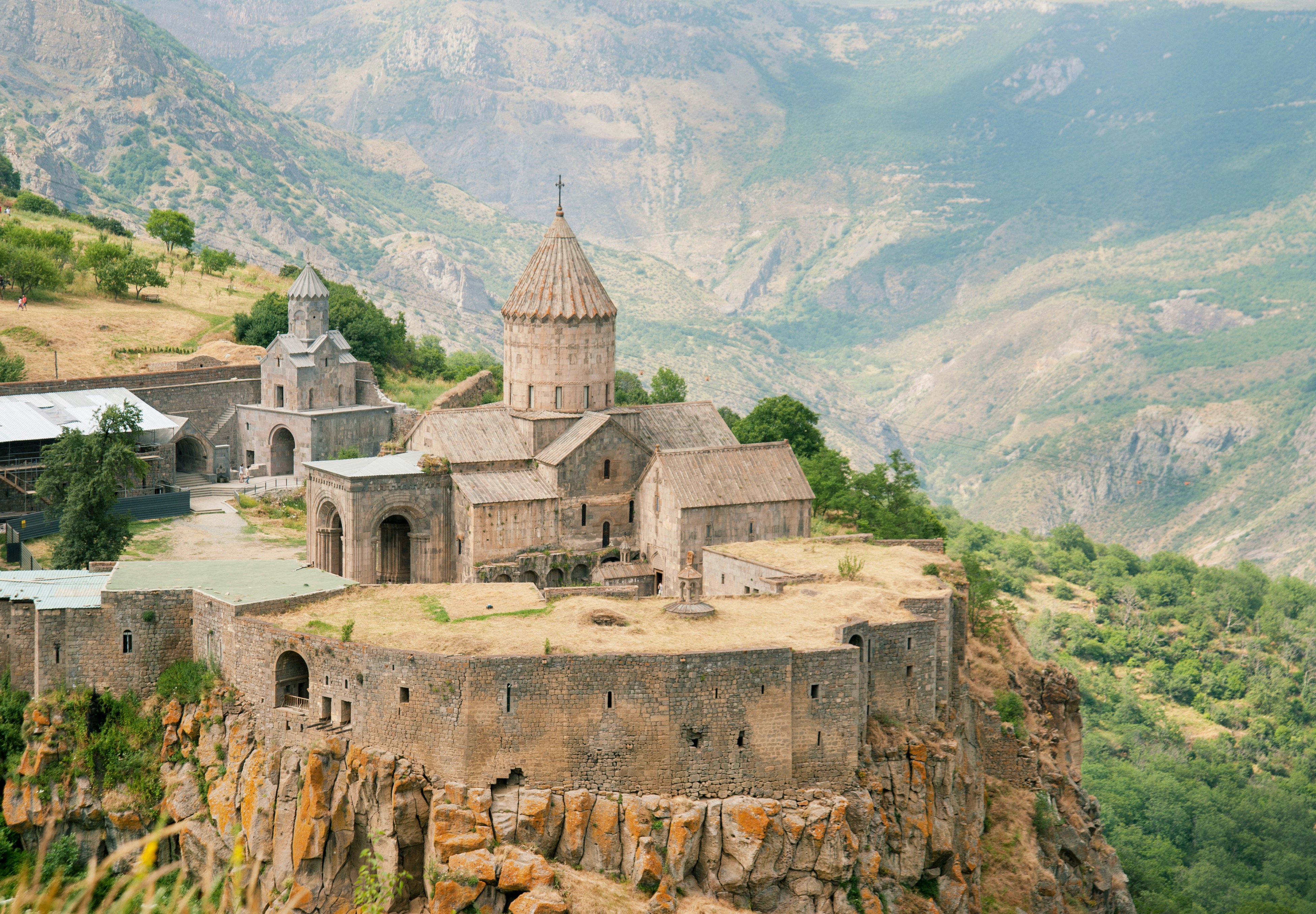
Yerevan has emerged as one of the region’s most compelling city-break destinations: a walkable capital with a lively café and bar culture built around pink tuff-stone buildings, outstanding Soviet-era architecture, and Mount Ararat as a constant backdrop. We cover the best spots to eat and drink in our eating out in Yerevan guide. Day trips from Yerevan reach Geghard Monastery, the temple at Garni, and the monastery complex at Khor Virap. Beyond the capital, Lake Sevan offers mountain scenery and fresh fish restaurants, while the Debed Canyon in Dilijan and the cable car to Tatev Monastery are popular multi-day routes.
Getting there
Connectivity improved significantly in 2026. Wizz Air launched direct flights from London to Yerevan on 12 June 2026, while FLYONE ARMENIA added twice-weekly Yerevan–Almaty services on the same date. Direct routes from Paris, Vienna, Milan Bergamo, Amsterdam, Dubai, Tbilisi and several other cities are also available. See our flights to Armenia page for current carriers and routes.
For a full breakdown of entry rules, standard visa-free nationalities and e-visa requirements, see our Armenia visa and entry guide. Planning your first visit? Make sure to arrange travel insurance for Armenia before you go. Our two-week Armenia itinerary combines Yerevan with Tatev, Dilijan, Lake Sevan, and the south.