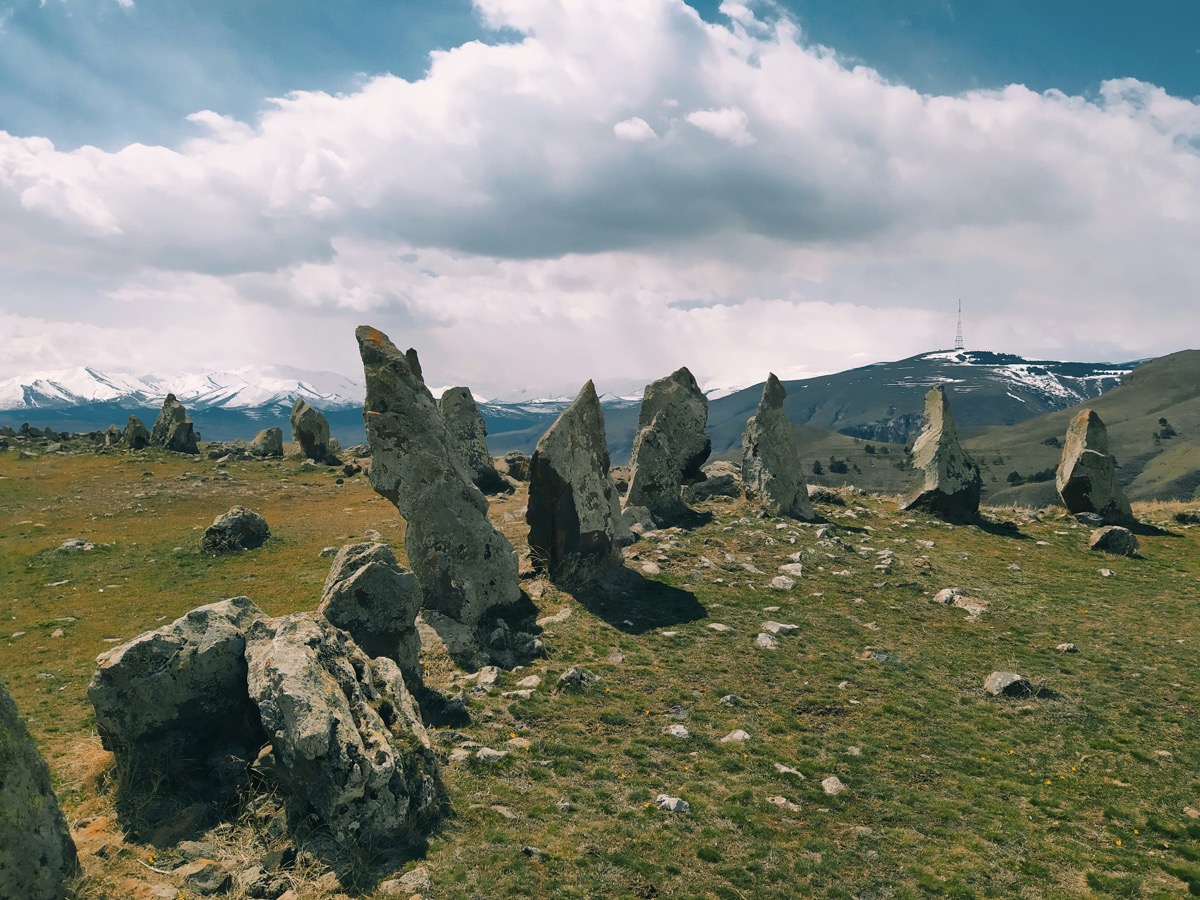
Karahunj - also written Carahunge or Qarahunj - is a Bronze Age megalithic complex set on a hilltop plateau above the Dar river valley, 3km north of the town of Sisian in Syunik Province. Its 223 basalt standing stones, some over 3 metres tall and weighing several tons, make it one of the most significant prehistoric sites in the South Caucasus.
What sets Karahunj apart from other Bronze Age stone fields is the presence of deliberate circular holes drilled through approximately 80 of the upright stones - holes that appear to have been used for astronomical sightings. This is the basis for comparisons to Stonehenge and for the site’s popular nickname, Armenia’s Stonehenge, though the two complexes are geographically and culturally unrelated.
Entry is approximately 500 AMD as of 2026. The site is open daily from approximately 10:00–18:00.
The Stones: What You Are Looking At
The site covers roughly 7 hectares of open plateau at an elevation of about 1,770 metres. The plateau itself is an asset - the views south across the Dar valley and north towards the distant ranges of Vayots Dzor are unobstructed and dramatic, particularly in spring (when snow remains on higher peaks) and autumn (when the valley is amber and rust).
The stones are arranged in several distinct groupings:
The central circle is the visual centrepiece: a roughly oval arrangement of upright stones on the highest point of the plateau. Some of the tallest stones - 2.5–3 metres above ground - stand here, and it is these that bear the drilled holes most visibly.
The north and south avenues extend from the central circle in long, roughly linear arrangements - similar in concept to the processional avenues at other megalithic sites in Europe and the Middle East, though the function remains unknown.
Outlying stones and burial cists scatter across the wider plateau. Archaeological excavations have found human remains and Bronze Age artefacts in stone cists adjacent to several uprights, confirming a funerary function at the site alongside whatever astronomical or ceremonial purposes the holed stones served.
The Astronomical Theory
In the 1990s, Armenian physicist and astronomer Paris Herouni proposed that Karahunj was a sophisticated astronomical observatory dating to around 7,500 BC, predating the earliest Stonehenge constructions by over 4,000 years. Herouni argued that specific holes in specific stones align with sunrise and sunset points at solstices and equinoxes, and with the rise and set of Deneb (the brightest star of the Cygnus constellation) at the proposed founding date.
The claim generated international attention and has been taken up enthusiastically in popular accounts of the site. Mainstream archaeologists are more cautious. Most date the complex to the Bronze Age, approximately 3,500–2,500 BC, based on the typology of the stone tools found, the construction techniques, and comparative evidence from other Caucasian megalithic sites. At that dating, Karahunj is broadly contemporary with - or marginally earlier than - the earliest phases of Stonehenge, which is remarkable enough without the additional millennia.
The astronomical dimension is not dismissed outright. Some of the hole alignments do correspond to astronomically significant rising and setting points, and a handful of researchers with backgrounds in both archaeology and archaeoastronomy have taken the orientation data seriously. Whether the holes were used for astronomical sighting, for symbolic or ritual purposes, or for structural reasons related to the stone-raising process is still actively debated.
What is not in doubt: someone spent considerable effort drilling circular holes through very hard basalt, and the positions of those holes are not random.
Visiting Karahunj: Practical Information
The site has a small gatehouse at the entrance, a basic information panel in Armenian and English, and a gravel path that loops through the main stone groupings. There is no audio guide, no cafe, and no shade on the plateau - bring water and sun protection in summer. A single portable toilet is available near the entrance.
Entry fee: approximately 500 AMD per person as of 2026.
Opening hours: approximately 10:00–18:00 daily. The site is accessible outside these hours (there is no fence across the full perimeter) but the gatehouse and ticket office will be closed.
Time to allow: 1.5–2.5 hours to walk the main circuit at a relaxed pace and take photographs. The full perimeter of the site, including the outlying stone groupings, takes closer to 3 hours.
Photography: Karahunj is outstanding for photography, particularly in early morning or late afternoon light when shadows fall between the stones and the surrounding plateau turns gold. The site faces west and southwest, making afternoon the better light direction for the central circle.
Facilities: minimal. Fill water bottles before leaving Sisian. The nearest cafe is in Sisian town, 3km south.
Getting There
From Yerevan
Karahunj is approximately 225km from Yerevan - 4.5–5 hours by car driving south on the M2 highway via Ararat and Yeghegnadzor, then continuing south through the mountains to Sisian. The road is paved throughout and scenically varied: it climbs through the mountains of Vayots Dzor before descending into the Syunik plateau.
By marshrutka: Shared minibuses from Yerevan’s Kilikia Bus Station run to Sisian (approximately 3,000–4,000 AMD, 4–4.5 hours). From Sisian, take a local taxi to the site - approximately 1,000–2,000 AMD one way. Return marshrutkas from Sisian to Yerevan typically depart in the morning; confirm times locally.
By private car or driver: The most comfortable option and gives flexibility to continue to Tatev the same day. Renting a car from Yerevan costs from approximately 18,000–25,000 AMD per day as of 2026. A private driver from Yerevan for a Karahunj–Tatev day trip runs approximately 35,000–55,000 AMD per vehicle.
Guided tour: Tours from Yerevan combining Karahunj and Tatev in a single long day are available from operators including Envoy Hostel Tours, Hyur Service, and OREX Travel. Shared departures from approximately 15,000–22,000 AMD per person; private tours from approximately 38,000 AMD. See our Tatev & south Armenia tours page for current options.
From Goris
Sisian (and Karahunj) is 60km west of Goris, approximately 50 minutes by car on the M2. A taxi from Goris to Karahunj costs approximately 8,000–12,000 AMD return as of 2026, depending on waiting time.
Nearby Attractions
Tatev Monastery (30km east)
Tatev Monastery is the obvious pairing with Karahunj. The 9th-century monastery sits on a cliff above the Vorotan gorge, reached by the Wings of Tatev - the world’s longest non-stop double-track aerial tramway at 5.7km. The cable car costs approximately 7,000 AMD return as of 2026. From Karahunj, the drive to the cable car’s lower terminal at Halidzor takes about 35 minutes on the M17 road east of Sisian. See the full Tatev Monastery guide for entry fees, hiking trails, and transport details. If you’re not driving, guided Tatev tours from Yerevan cover both Karahunj and Tatev on the same day.
Shaki Waterfall (20km south of Sisian)
The Shaki Waterfall drops approximately 18 metres over a basalt ledge into a narrow gorge, fed by meltwater from the Zangezur mountains. It is at its most powerful in spring and early summer. The waterfall is reachable via a short walk (about 20 minutes each way) from a roadside car park. Entry is free. The road south from Sisian towards the Iranian border passes close to the waterfall - it is a straightforward detour.
Sisian Museum
The small Sisian Regional Museum in the town centre has a collection of Bronze Age artefacts excavated from Karahunj and surrounding sites, including stone tools, jewellery, and fragments of ceramics. If you want context for what you have seen at the stones, the museum is worth 30–45 minutes. Entry is minimal - approximately 200–500 AMD as of 2026.
Where to Stay
Sisian
Sisian (population approximately 12,000) is a quiet provincial town with a handful of small guesthouses and hotels. Prices typically run 8,000–18,000 AMD per night for a double room as of 2026; search Booking.com or Google Maps for current options - the inventory is small and not always consistently listed across platforms.
Goris
For a wider choice of accommodation - particularly if you plan to visit Tatev Monastery as part of a longer Syunik loop - Goris (60km east) is the better base. Mirhav Hotel is the town’s main option, with stylish rooms from approximately 15,000–35,000 AMD per night as of 2026; several smaller guesthouses cover the budget end from around 12,000 AMD. For a full overview of accommodation in Goris and Tatev, see our where to stay near Tatev and Goris guide.
Best Time to Visit
May through October are the viable months. The plateau is at its most photogenic in May (green grass, snow still visible on higher peaks to the north) and late September through October (golden light, clear skies, almost no other visitors). July and August are warm and have the longest days but can feel exposed on the treeless plateau at midday.
Winter is inadvisable unless you have a vehicle with snow tyres and are comfortable on mountain roads. Sisian sits at 1,500 metres and can receive significant snowfall from November through March. The site itself is not closed in winter, but access from Yerevan in poor conditions is a serious undertaking.
For broader timing context, see our best time to visit Armenia guide.
Karahunj Within a Wider South Armenia Route
Karahunj works well as a standalone day trip from Yerevan (long, but feasible), or - better - as part of a multi-day south Armenia loop. A logical 2–3 day route from Yerevan covers Noravank (Noravank Monastery in Vayots Dzor), then drives south through the mountains to Karahunj, continues to Tatev and Goris for the night, then returns via the Khndzoresk cave village or the Vorotan gorge.
For a fully structured version of this route with hotel recommendations and daily budgets, see our 7-day south Armenia itinerary or the Armenia road trip guide. For a car hire in Armenia, the M2 south from Yerevan to Sisian is well-paved and straightforward to navigate independently. For those preferring a guided experience, our Armenia tours guide covers day-trip and multi-day options that include Karahunj alongside Tatev and Noravank.