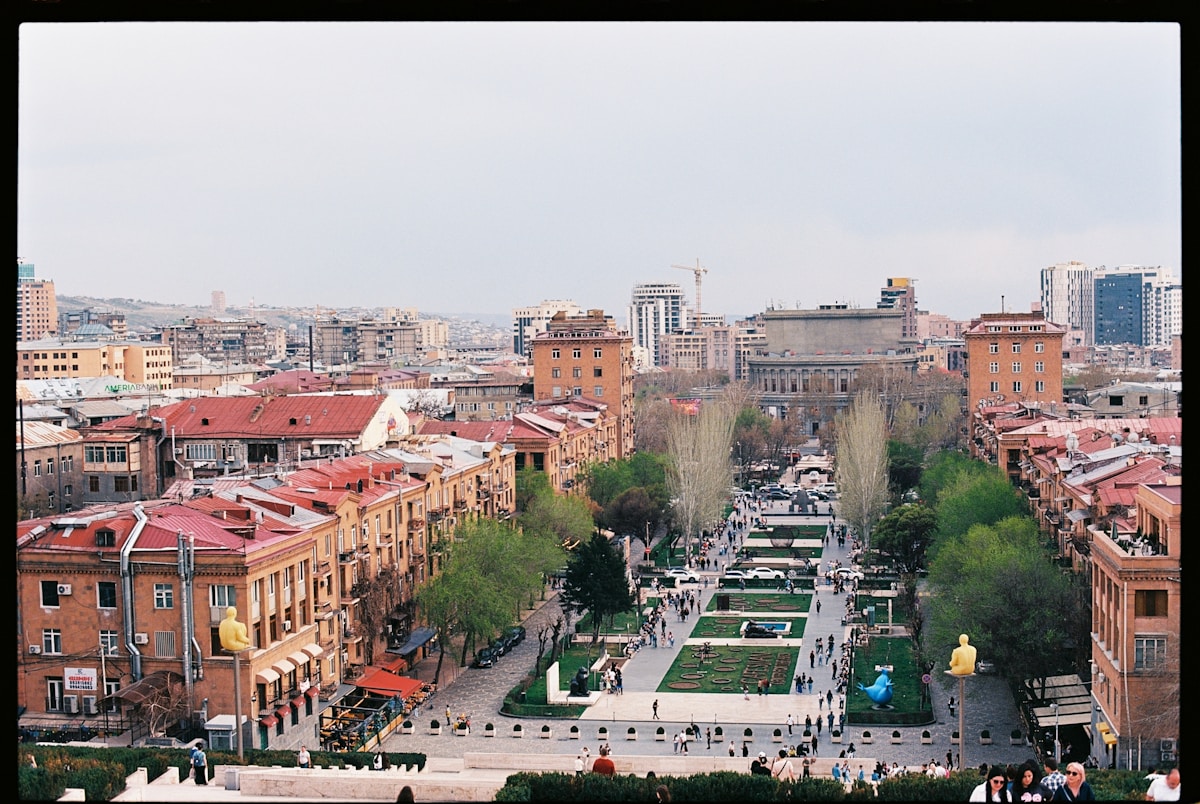
Armenia and Azerbaijan share a short land border that has been sealed to civilian traffic for decades. This single fact shapes every decision a traveller makes when planning a Caucasus trip: you will visit one or the other, not both in the same overland loop. This comparison is for travellers weighing up which country to choose, given the conflict context, the different tourism offerings, and the practical realities of entry and access.
Prices are approximate as of 2026. Verify current entry requirements on your government’s foreign travel advice page before booking.
The Closed Border: What Travellers Need to Know
Armenia and Azerbaijan have no open land border crossing. The conflict over Nagorno-Karabakh - which escalated sharply in 2020 and concluded with Azerbaijan taking full control of the territory in September 2023 - left formal diplomatic relations between the two countries in fragile condition. A peace treaty was in negotiation as of 2026, but the border remained closed to civilian travel.
For travellers, this has two practical implications:
First, you cannot travel overland between the two countries. If you want to see both, you must fly via a third country - typically Tbilisi, Istanbul, or Moscow - adding significant cost and travel time to the itinerary.
Second, travellers with Armenian passport stamps or travel documents showing travel to Armenia have historically faced complications entering Azerbaijan. The situation has evolved over time, and policies may change as peace negotiations progress - check current entry requirements carefully. Citizens of Armenia cannot enter Azerbaijan at all.
The inverse is also true: Armenian border authorities may scrutinise or deny entry to travellers with Azerbaijani stamps, particularly stamps from border points in the contested territories. In practice, many nationalities travel to both countries without incident, but the risk is real and worth researching before you plan.
The practical conclusion: plan Armenia and Azerbaijan as separate trips, not segments of the same Caucasus journey.
What Armenia Offers
Armenia’s tourism strengths are concentrated and accessible. The country is small - roughly the size of Belgium - and the main attractions sit within a few hours’ drive of Yerevan. Medieval monasteries carved into gorge walls or perched on volcanic ridges are the defining image: Geghard, Noravank, Khor Virap, and the UNESCO-listed Haghpat and Sanahin monasteries in the Debed Canyon. Lake Sevan provides a high-altitude counterpoint at 1,900 metres.
Yerevan - a Soviet-planned city built from pink tufa stone - has a genuine café culture, a lively dining scene on Saryan Street and around the Cascade, and the Tsitsernakaberd memorial complex documenting the Armenian Genocide. The city is compact and walkable.
Armenia’s strengths, summarised:
- High density of medieval Christian architecture - more UNESCO monasteries in a smaller area than almost anywhere in the region
- Compact geography - you can cover the main circuit in 6–7 days without feeling rushed
- Cost - one of the most affordable countries in the region for accommodation, food, and transport
- Brandy culture - ARARAT and other Armenian brandy (cognac-style) is excellent and cheap at source
- Safety - low crime, welcoming to tourists, straightforward for solo travellers
Armenia’s limitations: limited beach options, modest nightlife compared to Tbilisi, and rural areas with minimal tourist infrastructure that reward a hire car rather than public transport.
What Azerbaijan Offers
Azerbaijan is a different proposition. The country spans the Absheron Peninsula on the Caspian Sea to forested mountain valleys in the northwest and subtropical lowlands in the south. The headline attraction is Baku - a city where a medieval walled Old City (İçərişəhər, UNESCO World Heritage) sits against a backdrop of the flame-shaped towers that have become the country’s modern symbol. The contrast between the 12th-century Maiden Tower and the glass towers of the new city is genuinely striking.
Outside Baku: Gobustan holds petroglyphs dating back 40,000 years alongside the world’s largest concentration of mud volcanoes - a landscape found nowhere else in the region. Yanar Dag (Burning Mountain) is a naturally occurring gas seep that has burned permanently for decades. The Ateshgah fire temple on the Absheron Peninsula was an active Zoroastrian and Hindu pilgrimage site through the 19th century.
Sheki in the northwest - a 3-hour drive or train journey from Baku - contains a 18th-century Khan’s Palace decorated with elaborate stained-glass panels and interior frescoes, and a surviving caravanserai from the Silk Road era. This alone justifies extending a Baku trip.
Azerbaijan’s strengths, summarised:
- Baku’s architectural contrast - UNESCO medieval city plus striking modern skyline
- Gobustan - unique geological landscape and one of the world’s oldest rock art sites
- Sheki and the northwest - medieval Silk Road town with exceptional palace and crafts tradition
- Cuisine - Azerbaijani food (plov, dolma variations, sturgeon dishes, pomegranate-based sauces) is distinctive and not widely exported
- Scale - larger country with more geographic variety than Armenia
Azerbaijan’s limitations: English is less widely spoken outside Baku than in Yerevan; alcohol is available but cultural context is different (majority Muslim country); some rural infrastructure is less developed for independent travellers.
Historical Sites
Armenia has the edge in Christian heritage. As the world’s first Christian nation (301 AD), it has a dense network of 4th–13th century monasteries, many in dramatic natural settings. Khachkars (carved cross-stones) are found throughout the countryside and represent a distinctive medieval artistic tradition.
Azerbaijan has Gobustan’s rock art (UNESCO), the walled Old City of Baku (UNESCO), Sheki’s palace and caravanserai (UNESCO), and strong connections to the Zoroastrian and Silk Road eras. Its heritage is more diverse chronologically - spanning pre-Christian, Islamic, and Soviet layers - but less concentrated in one tradition.
Verdict: Armenia for concentrated medieval Christian architecture; Azerbaijan for broader historical and cultural layers from multiple civilisations.
Food
Armenian food centres on khorovats (charcoal-grilled meat), dolma, and lavash - the UNESCO-listed thin flatbread baked on the wall of a clay tonir oven. The food is meat-heavy, herb-forward, and excellent paired with cold beer or fruit vodka (oghi). Yerevan’s restaurant scene has grown significantly in recent years.
Azerbaijani food draws on Turkish, Persian, and Central Asian influences. Plov (saffron rice with various toppings including dried fruit and chestnuts) is the national dish. Lavangi (chicken or fish stuffed with walnut-herb paste) is a regional speciality from Lankaran. Sturgeon from the Caspian, pomegranate molasses, and herb-filled pastries (qutab) are all worth seeking out. Baku’s dining scene has expanded considerably with international options alongside traditional Azerbaijani restaurants.
Verdict: Different traditions rather than one better than the other. Armenian food is more familiar to European palates; Azerbaijani food has more distinctive Central Asian and Persian notes.
Cost of Travel
Both countries are affordable by Western European standards.
Armenia is slightly cheaper overall - accommodation in Yerevan runs from approximately USD 25–50 for a good guesthouse or boutique hotel, and a full meal with drinks in a mid-range restaurant rarely exceeds USD 15 per person. Transport by marshrutka between towns costs a few dollars. See our Armenia budget travel guide for a full breakdown.
Baku has seen significant price increases as oil revenues funded a wave of hotel construction and infrastructure investment. A mid-range hotel in Baku now runs USD 60–120 per night. Outside Baku, prices drop sharply. A rough budget for Azerbaijan as a whole is USD 50–80 per day for comfortable independent travel.
Verdict: Armenia is noticeably cheaper, particularly for accommodation and food.
Safety and Travel Advisories
Armenia is rated low-risk for most travellers. The main advisory note is the border with Azerbaijan - areas in the Syunik region near the border warrant checking before any travel to the far south-east, and the situation along the former line of contact is sensitive. The main tourist circuit (Yerevan, central and northern Armenia) is unaffected. See our Armenia safety guide for detail.
Azerbaijan is generally safe in Baku and the main tourist areas. The same border-area caution applies from the Azerbaijani side. Solo travel in Baku is straightforward; attitudes toward women in more rural areas are more conservative than in the capital.
Both countries’ foreign ministries issue current travel advisories - check these before booking rather than relying on general ratings.
Who Should Choose Armenia
- Travellers focused on medieval Christian heritage and archaeology
- Those with a week or less who want a compact, high-impact trip
- Budget travellers - Armenia stretches money further
- People interested in the Armenian Genocide and its history
- Hikers wanting access to the Dilijan forests or Zangezur mountains
- First-time Caucasus visitors who want a manageable entry point
Who Should Choose Azerbaijan
- Travellers interested in Silk Road history and Islamic architecture alongside Christian heritage
- Those who want a city break centred on a genuinely striking capital (Baku)
- Visitors with interest in geology - Gobustan’s mud volcanoes are unique
- Longer trips that can combine Baku with Sheki and the northwest
- Travellers arriving from Turkey or Central Asia, where Azerbaijan sits more naturally in a regional route
Frequently Asked Questions
Can I visit both Armenia and Azerbaijan on the same trip?
Not by land. The border between Armenia and Azerbaijan is closed. To visit both, you would need to fly via a third country (Tbilisi, Istanbul, and Moscow are the common routes). Additionally, travellers with Armenian stamps may face difficulties entering Azerbaijan - check current entry requirements before planning a combined visit.
Do I need a visa for Armenia or Azerbaijan?
Citizens of EU/EEA countries, USA, UK, Canada, and Australia can enter Armenia without a visa for stays up to 180 days. Azerbaijan offers an e-visa (ASAN Visa) for most Western passport holders - apply at least 3 business days in advance. Check current requirements for your specific nationality before travel. See our full Armenia visa guide for Armenian entry rules.
Is Nagorno-Karabakh accessible to tourists?
As of 2026, no. The territory is under Azerbaijani control following the September 2023 military operation; the ethnic Armenian population departed. Entry for tourists without express Azerbaijani government authorisation is not possible and would be inadvisable. Monitor official travel advisories for any changes.
Which country is better for solo travellers?
Both are safe for solo travel by most standards. Armenia is marginally more straightforward for first-time solo travellers - English is more widely spoken in Yerevan, distances are shorter, and the tourism infrastructure on the main circuit is well-practised. Solo women report positive experiences in both countries in the main tourist areas.
Plan Your Trip to Armenia
🏨 Search hotels in Yerevan 🎟️ Browse Armenia tours and day trips ✈️ Compare flights to Armenia 🛡️ Get travel insurance for Armenia 📱 Stay connected with an Armenia SIM card